FOMC Service Report

16S rRNA Gene V1V3 Amplicon Sequencing

Version V1.52

Version History

The Forsyth Institute, Cambridge, MA, USA
November 09, 2025

Project ID: FOMC26947


I. Project Summary

Project FOMC26947 services include NGS sequencing of the V1V3 region of the 16S rRNA gene amplicons from the samples. First and foremost, please download this report, as well as the sequence raw data from the download links provided below. These links will expire after 60 days. We cannot guarantee the availability of your data after 60 days.

Full Bioinformatics analysis service was requested. We provide many analyses, starting from the raw sequence quality and noise filtering, pair reads merging, as well as chimera filtering for the sequences, using the DADA2 denosing algorithm and pipeline.

We also provide many downstream analyses such as taxonomy assignment, alpha and beta diversity analyses, and differential abundance analysis.

For taxonomy assignment, most informative would be the taxonomy barplots. We provide an interactive barplots to show the relative abundance of microbes at different taxonomy levels (from Phylum to species) that you can choose.

If you specify which groups of samples you want to compare for differential abundance, we provide both ANCOM and LEfSe differential abundance analysis.


II. Workflow Checklist

1.Sample Received
2.Sample Quality Evaluated
3.Sample Prepared for Sequencing
4.Next-Gen Sequencing
5.Sequence Quality Check
6.Absolute Abundance
7.Report and Raw Sequence Data Available for Download
8.Bioinformatics Analysis - Reads Processing (DADA2 Quality Trimming, Denoising, Paired Reads Merging)
9.Bioinformatics Analysis - Reads Taxonomy Assignment
10.Bioinformatics Analysis - Alpha Diversity Analysis
11.Bioinformatics Analysis - Beta Diversity Analysis
12.Bioinformatics Analysis - Differential Abundance Analysis
13.Bioinformatics Analysis - Heatmap Profile
14.Bioinformatics Analysis - Network Association
 

III. NGS Sequencing

The samples were processed and analyzed with the ZymoBIOMICS® Service: Targeted Metagenomic Sequencing (Zymo Research, Irvine, CA).

DNA Extraction: If DNA extraction was performed, the following DNA extraction kit was used according to the manufacturer’s instructions:

ZymoBIOMICS®-96 MagBead DNA Kit (Zymo Research, Irvine, CA)
N/A (DNA Extraction Not Performed)
Elution Volume: 50µL
Additional Notes: NA

Targeted Library Preparation: The DNA samples were prepared for targeted sequencing with the Quick-16S™ NGS Library Prep Kit (Zymo Research, Irvine, CA). These primers were custom designed by Zymo Research to provide the best coverage of the 16S gene while maintaining high sensitivity. The primer sets used in this project are marked below:

Quick-16S™ Primer Set V1-V2 (Zymo Research, Irvine, CA)
Quick-16S™ Primer Set V1-V3 (Zymo Research, Irvine, CA)
Quick-16S™ Primer Set V3-V4 (Zymo Research, Irvine, CA)
Quick-16S™ Primer Set V4 (Zymo Research, Irvine, CA)
Quick-16S™ Primer Set V6-V8 (Zymo Research, Irvine, CA)
Additional Notes: NA

The sequencing library was prepared using an innovative library preparation process in which PCR reactions were performed in real-time PCR machines to control cycles and therefore limit PCR chimera formation. The final PCR products were quantified with qPCR fluorescence readings and pooled together based on equal molarity. The final pooled library was cleaned up with the Select-a-Size DNA Clean & Concentrator™ (Zymo Research, Irvine, CA), then quantified with TapeStation® (Agilent Technologies, Santa Clara, CA) and Qubit® (Thermo Fisher Scientific, Waltham, WA).

Control Samples: The ZymoBIOMICS® Microbial Community Standard (Zymo Research, Irvine, CA) was used as a positive control for each DNA extraction, if performed. The ZymoBIOMICS® Microbial Community DNA Standard (Zymo Research, Irvine, CA) was used as a positive control for each targeted library preparation. Negative controls (i.e. blank extraction control, blank library preparation control) were included to assess the level of bioburden carried by the wet-lab process.

Sequencing: The final library was sequenced on Illumina® NextSeq 2000™ with a p1 (Illumina, Sand Diego, CA) reagent kit (600 cycles). The sequencing was performed with 25% PhiX spike-in.

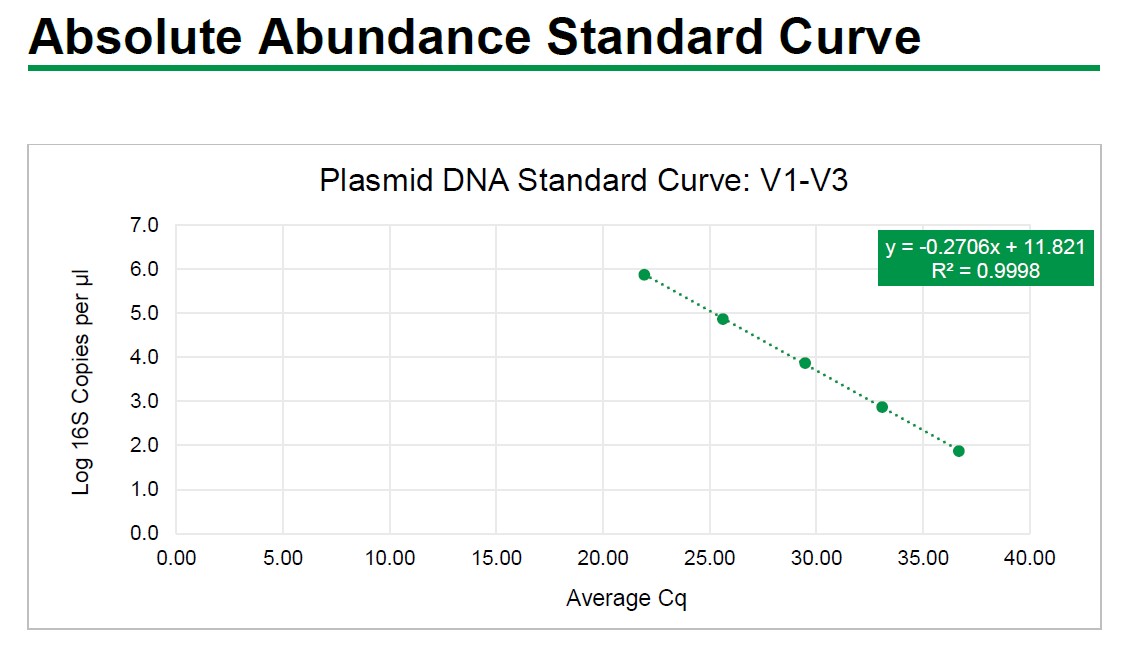
Absolute Abundance Quantification*: A quantitative real-time PCR was set up with a standard curve. The standard curve was made with plasmid DNA containing one copy of the 16S gene and one copy of the fungal ITS2 region prepared in 10-fold serial dilutions. The primers used were the same as those used in Targeted Library Preparation. The equation generated by the plasmid DNA standard curve was used to calculate the number of gene copies in the reaction for each sample. The PCR input volume (2 µl) was used to calculate the number of gene copies per microliter in each DNA sample.
The number of genome copies per microliter DNA sample was calculated by dividing the gene copy number by an assumed number of gene copies per genome. The value used for 16S copies per genome is 4. The value used for ITS copies per genome is 200. The amount of DNA per microliter DNA sample was calculated using an assumed genome size of 4.64 x 10⁶ bp, the genome size of Escherichia coli, for 16S samples, or an assumed genome size of 1.20 x 10⁷ bp, the genome size of Saccharomyces cerevisiae, for ITS samples. This calculation is shown below:

Calculated Total DNA = Calculated Total Genome Copies × Assumed Genome Size (4.64 × 10⁶ bp) ×
Average Molecular Weight of a DNA bp (660 g/mole/bp) ÷ Avogadro’s Number (6.022 x 10²³/mole)


* Absolute Abundance Quantification is only available for 16S and ITS analyses.

The absolute abundance standard curve data can be viewed in Excel here:

The absolute abundance standard curve is shown below:

Absolute Abundance Standard Curve


IV. Complete Report Download

The complete report of your project, including all links in this report, can be downloaded by clicking the link provided below. The downloaded file is a compressed ZIP file and once unzipped, open the file “REPORT.html” (may only shown as "REPORT" in your computer) by double clicking it. Your default web browser will open it and you will see the exact content of this report.

Please download and save the file to your computer storage device. The download link will expire after 60 days upon your receiving of this report.

Complete report download link:

To view the report, please follow the following steps:

1.Download the .zip file from the report link above.
2.Extract all the contents of the downloaded .zip file to your desktop.
3.Open the extracted folder and find the "REPORT.html" (may shown as only "REPORT").
4.Open (double-clicking) the REPORT.html file. Your default browser will open the top age of the complete report. Within the report, there are links to view all the analyses performed for the project.


V. Raw Sequence Data Download

The raw NGS sequence data is available for download with the link provided below. The data is a compressed ZIP file and can be unzipped to individual sequence files. Since this is a Pac-Bio full-length (V1V9) 16S rRNA amplicon sequencing, raw sequences are available for download in a single compressed zip file in the download link below. After unzipping, you will find individual sequence files for each of your samples with the file extension “*.fastq.gz”. The files are in FASTQ format and are compressed. FASTQ format is a text-based data format for storing both a biological sequence and its corresponding quality scores. Most sequence analysis software will be able to open them. The Sample IDs associated with the fastq files are listed in the table below:

Sample IDOriginal Sample IDRead 1 File NameRead 2 File Name
F26947.S10original sample ID herezr26947_10V1V3_R1.fastq.gzzr26947_10V1V3_R2.fastq.gz
F26947.S11original sample ID herezr26947_11V1V3_R1.fastq.gzzr26947_11V1V3_R2.fastq.gz
F26947.S12original sample ID herezr26947_12V1V3_R1.fastq.gzzr26947_12V1V3_R2.fastq.gz
F26947.S13original sample ID herezr26947_13V1V3_R1.fastq.gzzr26947_13V1V3_R2.fastq.gz
F26947.S14original sample ID herezr26947_14V1V3_R1.fastq.gzzr26947_14V1V3_R2.fastq.gz
F26947.S15original sample ID herezr26947_15V1V3_R1.fastq.gzzr26947_15V1V3_R2.fastq.gz
F26947.S16original sample ID herezr26947_16V1V3_R1.fastq.gzzr26947_16V1V3_R2.fastq.gz
F26947.S17original sample ID herezr26947_17V1V3_R1.fastq.gzzr26947_17V1V3_R2.fastq.gz
F26947.S18original sample ID herezr26947_18V1V3_R1.fastq.gzzr26947_18V1V3_R2.fastq.gz
F26947.S01original sample ID herezr26947_1V1V3_R1.fastq.gzzr26947_1V1V3_R2.fastq.gz
F26947.S02original sample ID herezr26947_2V1V3_R1.fastq.gzzr26947_2V1V3_R2.fastq.gz
F26947.S03original sample ID herezr26947_3V1V3_R1.fastq.gzzr26947_3V1V3_R2.fastq.gz
F26947.S04original sample ID herezr26947_4V1V3_R1.fastq.gzzr26947_4V1V3_R2.fastq.gz
F26947.S05original sample ID herezr26947_5V1V3_R1.fastq.gzzr26947_5V1V3_R2.fastq.gz
F26947.S06original sample ID herezr26947_6V1V3_R1.fastq.gzzr26947_6V1V3_R2.fastq.gz
F26947.S07original sample ID herezr26947_7V1V3_R1.fastq.gzzr26947_7V1V3_R2.fastq.gz
F26947.S08original sample ID herezr26947_8V1V3_R1.fastq.gzzr26947_8V1V3_R2.fastq.gz
F26947.S09original sample ID herezr26947_9V1V3_R1.fastq.gzzr26947_9V1V3_R2.fastq.gz

Please download and save the file to your computer storage device. The download link will expire after 60 days upon your receiving of this report.

Raw sequence data download link:


VI. Analysis - DADA2 Read Processing

What is DADA2?

DADA2 is a software package that models and corrects Illumina-sequenced amplicon errors [1]. DADA2 infers sample sequences exactly, without coarse-graining into OTUs, and resolves differences of as little as one nucleotide. DADA2 identified more real variants and output fewer spurious sequences than other methods.

DADA2’s advantage is that it uses more of the data. The DADA2 error model incorporates quality information, which is ignored by all other methods after filtering. The DADA2 error model incorporates quantitative abundances, whereas most other methods use abundance ranks if they use abundance at all. The DADA2 error model identifies the differences between sequences, eg. A->C, whereas other methods merely count the mismatches. DADA2 can parameterize its error model from the data itself, rather than relying on previous datasets that may or may not reflect the PCR and sequencing protocols used in your study.

DADA2 Software Package is available as an R package at : https://benjjneb.github.io/dada2/index.html

References

  1. Callahan BJ, McMurdie PJ, Rosen MJ, Han AW, Johnson AJ, Holmes SP. DADA2: High-resolution sample inference from Illumina amplicon data. Nat Methods. 2016 Jul;13(7):581-3. doi: 10.1038/nmeth.3869. Epub 2016 May 23. PMID: 27214047; PMCID: PMC4927377.

Analysis Procedures:

DADA2 pipeline includes several tools for read quality control, including quality filtering, trimming, denoising, pair merging and chimera filtering. Below are the major processing steps of DADA2:

Step 1. Read trimming based on sequence quality The quality of NGS Illumina sequences often decreases toward the end of the reads. DADA2 allows to trim off the poor quality read ends in order to improve the error model building and pair mergicing performance.

Step 2. Learn the Error Rates The DADA2 algorithm makes use of a parametric error model (err) and every amplicon dataset has a different set of error rates. The learnErrors method learns this error model from the data, by alternating estimation of the error rates and inference of sample composition until they converge on a jointly consistent solution. As in many machine-learning problems, the algorithm must begin with an initial guess, for which the maximum possible error rates in this data are used (the error rates if only the most abundant sequence is correct and all the rest are errors).

Step 3. Infer amplicon sequence variants (ASVs) based on the error model built in previous step. This step is also called sequence "denoising". The outcome of this step is a list of ASVs that are the equivalent of oligonucleotides.

Step 4. Merge paired reads. If the sequencing products are read pairs, DADA2 will merge the R1 and R2 ASVs into single sequences. Merging is performed by aligning the denoised forward reads with the reverse-complement of the corresponding denoised reverse reads, and then constructing the merged “contig” sequences. By default, merged sequences are only output if the forward and reverse reads overlap by at least 12 bases, and are identical to each other in the overlap region (but these conditions can be changed via function arguments).

Step 5. Remove chimera. The core dada method corrects substitution and indel errors, but chimeras remain. Fortunately, the accuracy of sequence variants after denoising makes identifying chimeric ASVs simpler than when dealing with fuzzy OTUs. Chimeric sequences are identified if they can be exactly reconstructed by combining a left-segment and a right-segment from two more abundant “parent” sequences. The frequency of chimeric sequences varies substantially from dataset to dataset, and depends on on factors including experimental procedures and sample complexity.

Results

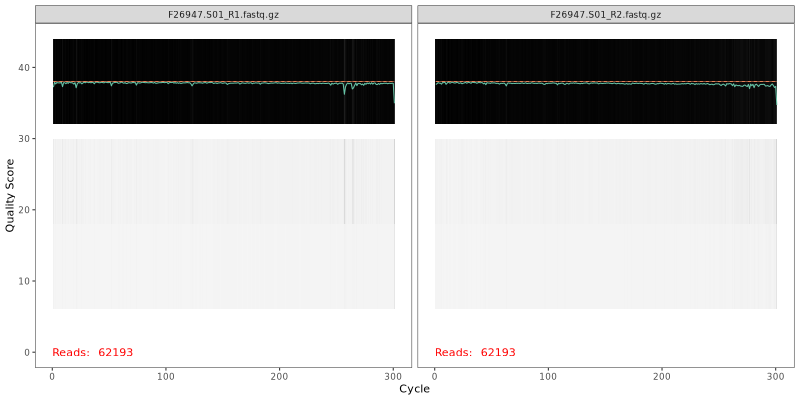
1. Read Quality Plots NGS sequence analaysis starts with visualizing the quality of the sequencing. Below are the quality plots of the first sample for the R1 and R2 reads separately. In gray-scale is a heat map of the frequency of each quality score at each base position. The mean quality score at each position is shown by the green line, and the quartiles of the quality score distribution by the orange lines. The forward reads are usually of better quality. It is a common practice to trim the last few nucleotides to avoid less well-controlled errors that can arise there. The trimming affects the downstream steps including error model building, merging and chimera calling. FOMC uses an empirical approach to test many combinations of different trim length in order to achieve best final amplicon sequence variants (ASVs), see the next section “Optimal trim length for ASVs”.

Quality plots for all samples:

2. Optimal trim length for ASVs The final number of merged and chimera-filtered ASVs depends on the quality filtering (hence trimming) in the very beginning of the DADA2 pipeline. In order to achieve highest number of ASVs, an empirical approach was used -

  1. Create a random subset of each sample consisting of 5,000 R1 and 5,000 R2 (to reduce computation time)
  2. Trim 10 bases at a time from the ends of both R1 and R2 up to 50 bases
  3. For each combination of trimmed length (e.g., 300x300, 300x290, 290x290 etc), the trimmed reads are subject to the entire DADA2 pipeline for chimera-filtered merged ASVs
  4. The combination with highest percentage of the input reads becoming final ASVs is selected for the complete set of data

Below is the result of such operation, showing ASV percentages of total reads for all trimming combinations (1st Column = R1 lengths in bases; 1st Row = R2 lengths in bases):

R1/R2301291281271261251
30184.03%84.21%84.40%84.87%84.94%76.78%
29184.01%84.19%84.36%84.51%75.89%63.18%
28184.31%84.49%84.32%75.61%63.14%12.46%
27185.16%85.14%75.99%63.23%12.41%8.82%
26185.04%76.13%62.98%12.32%8.84%4.60%
25176.57%63.55%12.71%8.91%4.65%1.89%

Based on the above result, the trim length combination of R1 = 271 bases and R2 = 301 bases (highlighted red above), was chosen for generating final ASVs for all sequences. This combination generated highest number of merged non-chimeric ASVs and was used for downstream analyses, if requested.

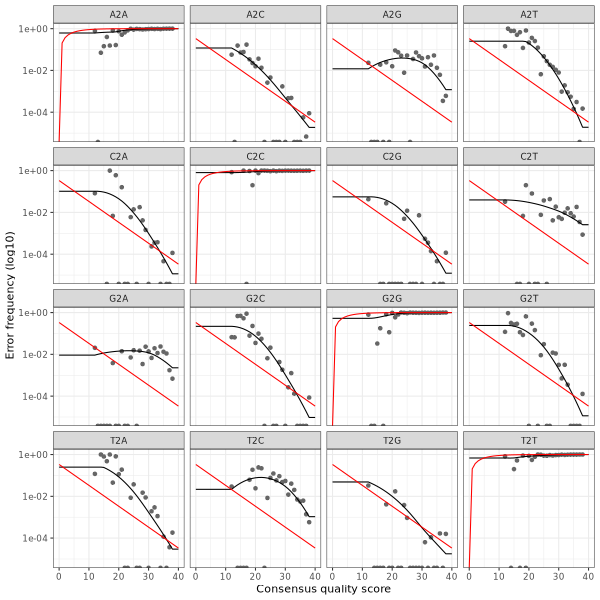
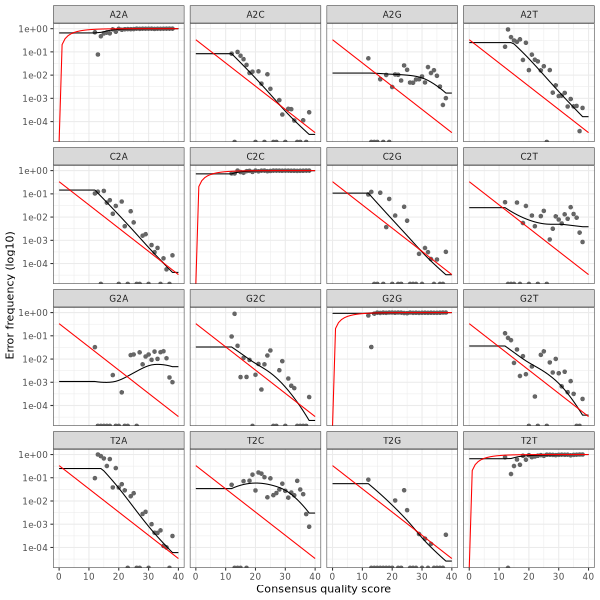
3. Error plots from learning the error rates After DADA2 building the error model for the set of data, it is always worthwhile, as a sanity check if nothing else, to visualize the estimated error rates. The error rates for each possible transition (A→C, A→G, …) are shown below. Points are the observed error rates for each consensus quality score. The black line shows the estimated error rates after convergence of the machine-learning algorithm. The red line shows the error rates expected under the nominal definition of the Q-score. The ideal result would be the estimated error rates (black line) are a good fit to the observed rates (points), and the error rates drop with increased quality as expected.

Forward Read R1 Error Plot


Reverse Read R2 Error Plot

The PDF version of these plots are available here:


4. DADA2 Result Summary The table below shows the summary of the DADA2 analysis, tracking paired read counts of each samples for all the steps during DADA2 denoising process - including end-trimming (filtered), denoising (denoisedF, denoisedF), pair merging (merged) and chimera removal (nonchim).

Sample IDF26947.S01F26947.S02F26947.S03F26947.S04F26947.S05F26947.S06F26947.S07F26947.S08F26947.S09F26947.S10F26947.S11F26947.S12F26947.S13F26947.S14F26947.S15F26947.S16F26947.S17F26947.S18Row SumPercentage
input62,193142,465207,463159,084254,673181,103105,74296,93691,463148,88493,221113,382153,34764,969188,690130,45795,539139,4272,429,038100.00%
filtered62,192142,463207,459159,083254,671181,100105,74196,93691,462148,88193,220113,381153,34264,969188,685130,45595,536139,4272,429,003100.00%
denoisedF61,817141,756206,431158,335253,632180,471105,06096,19790,821148,24492,854113,071152,79264,700188,117128,64794,035137,6532,414,63399.41%
denoisedR61,707140,924205,337156,920252,319179,199104,22295,10089,808147,32491,979112,947152,25164,473187,436126,57592,658135,3762,396,55598.66%
merged59,421134,864197,493150,282243,778171,63999,33690,26084,758141,92088,702110,365148,03162,495181,646116,63385,589125,4652,292,67794.39%
nonchim56,271120,828181,593137,275224,586155,57791,34784,07078,997131,32483,435106,789140,33959,694171,131103,55776,428112,4492,115,69087.10%

This table can be downloaded as an Excel table below:


5. DADA2 Amplicon Sequence Variants (ASVs). A total of 2645 unique merged and chimera-free ASV sequences were identified, and their corresponding read counts for each sample are available in the "ASV Read Count Table" with rows for the ASV sequences and columns for sample. This read count table can be used for microbial profile comparison among different samples and the sequences provided in the table can be used to taxonomy assignment.


The table can be downloaded from this link:


Sample Meta Information

Download Sample Meta Information
#SampleIDSampleNameNameGroupDay
F26947.S01F26947.S01P6B1A (D10) D10D10
F26947.S02F26947.S02P6B2B (D15)No_Treatment_D15D15
F26947.S03F26947.S03P6B3A (D15)No_Treatment_D15D15
F26947.S04F26947.S04P6B4B (D15)No_Treatment_D15D15
F26947.S05F26947.S05P6B5A (D22)No_Treatment_D22D22
F26947.S06F26947.S06P6B6A (D22)No_Treatment_D22D22
F26947.S07F26947.S07P6B7A (D15)Treatment_D15D15
F26947.S08F26947.S08P6B8B (D15)Treatment_D15D15
F26947.S09F26947.S09P6B9B (D15)Treatment_D15D15
F26947.S10F26947.S10P6B10A (D22)Treatment_D22D22
F26947.S11F26947.S11P6B11A (D22)Treatment_D22D22
F26947.S12F26947.S12P6B12A (D10)D10D10
F26947.S13F26947.S13P6B13A (D10)D10D10
F26947.S14F26947.S14P6B14A (D10)D10D10
F26947.S15F26947.S15P6B15B (D10) D10D10
F26947.S16F26947.S16h-plaque day 0D0D0
F26947.S17F26947.S17h-plaque day 0D0D0
F26947.S18F26947.S18h-plaque day 0D0D0


ASV Read Counts by Samples

#Sample IDRead Count
F26947.S0156,271
F26947.S1459,694
F26947.S1776,428
F26947.S0978,997
F26947.S1183,435
F26947.S0884,070
F26947.S0791,347
F26947.S16103,557
F26947.S12106,789
F26947.S18112,449
F26947.S02120,828
F26947.S10131,324
F26947.S04137,275
F26947.S13140,339
F26947.S06155,577
F26947.S15171,131
F26947.S03181,593
F26947.S05224,586


VII. Analysis - Read Taxonomy Assignment

Read Taxonomy Assignment - Methods


The close-reference taxonomy assignment of the ASV sequences using BLASTN is based on the algorithm published by Al-Hebshi et. al. (2015)[2].

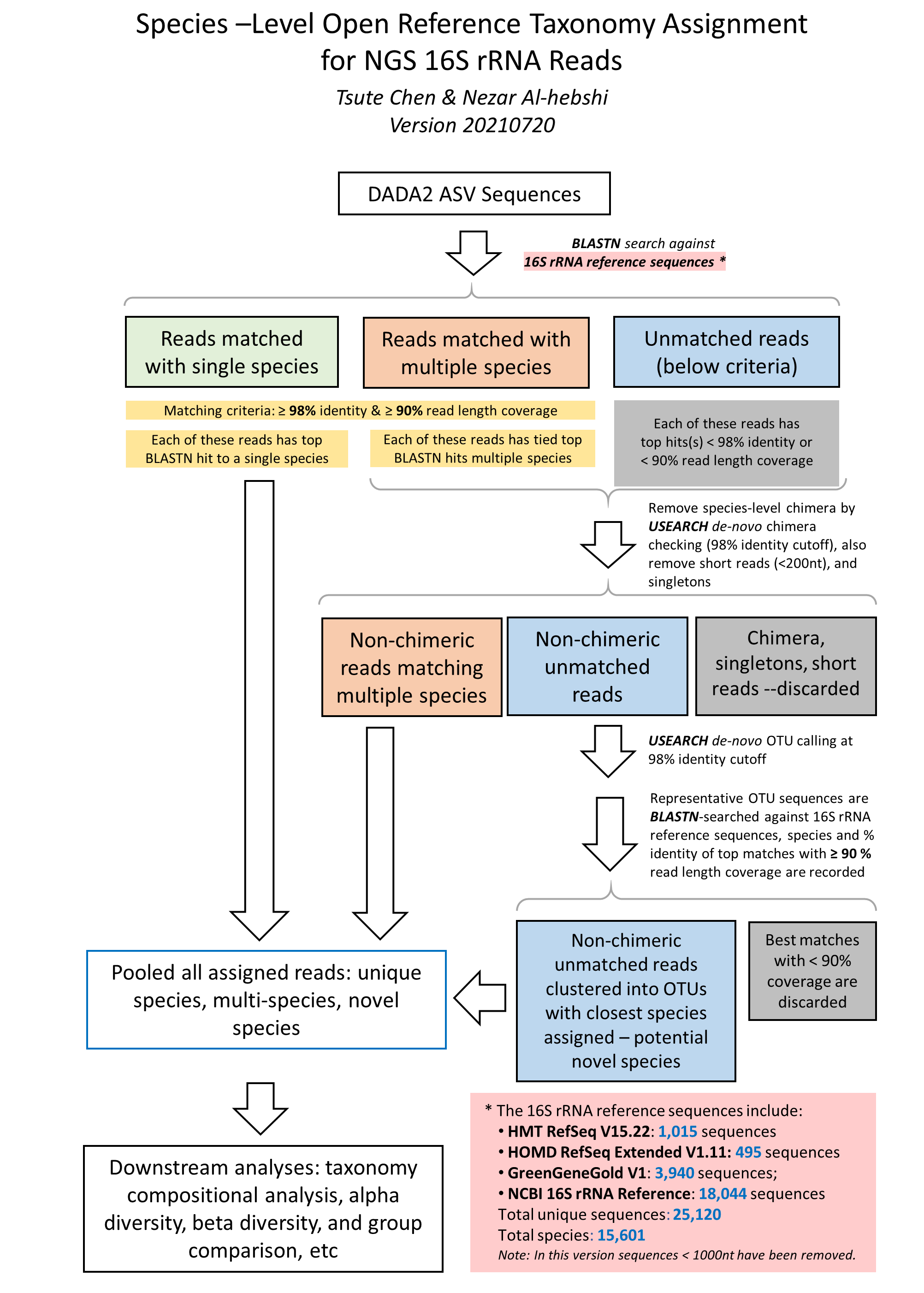
The species-level, open-reference 16S rRNA NGS reads taxonomy assignment pipeline

Version 20210310a


1. Raw sequences reads in FASTA format were BLASTN-searched against a combined set of 16S rRNA reference sequences - the FOMC 16S rRNA Reference Sequences version 20221029 (https://microbiome.forsyth.org/ftp/refseq/). This set consists of the HOMD (version 15.22 http://www.homd.org/index.php?name=seqDownload&file&type=R ), Mouse Oral Microbiome Database (MOMD version 5.1 https://momd.org/ftp/16S_rRNA_refseq/MOMD_16S_rRNA_RefSeq/V5.1/), and the NCBI 16S rRNA reference sequence set (https://ftp.ncbi.nlm.nih.gov/blast/db/16S_ribosomal_RNA.tar.gz). These sequences were screened and combined to remove short sequences (<1000nt), chimera, duplicated and sub-sequences, as well as sequences with poor taxonomy annotation (e.g., without species information). This process resulted in 1,015 full-length 16S rRNA sequences from HOMD V15.22, 356 from MOMD V5.1, and 22,126 from NCBI, a total of 23,497 sequences. Altogether these sequence represent a total of 17,035 oral and non-oral microbial species.

The NCBI BLASTN version 2.7.1+ (Zhang et al, 2000) [3] was used with the default parameters. Reads with ≥ 98% sequence identity to the matched reference and ≥ 90% alignment length (i.e., ≥ 90% of the read length that was aligned to the reference and was used to calculate the sequence percent identity) were classified based on the taxonomy of the reference sequence with highest sequence identity. If a read matched with reference sequences representing more than one species with equal percent identity and alignment length, it was subject to chimera checking with USEARCH program version v8.1.1861 (Edgar 2010). Non-chimeric reads with multi-species best hits were considered valid and were assigned with a unique species notation (e.g., spp) denoting unresolvable multiple species.

2. Unassigned reads (i.e., reads with < 98% identity or < 90% alignment length) were pooled together and reads < 200 bases were removed. The remaining reads were subject to the de novo operational taxonomy unit (OTU) calling and chimera checking using the USEARCH program version v8.1.1861 (Edgar 2010)[4]. The de novo OTU calling and chimera checking was done using 98% as the sequence identity cutoff, i.e., the species-level OTU. The output of this step produced species-level de novo clustered OTUs with 98% identity. Representative reads from each of the OTUs/species were then BLASTN-searched against the same reference sequence set again to determine the closest species for these potential novel species. These potential novel species were pooled together with the reads that were signed to specie-level in the previous step, for down-stream analyses.

Reference:

  1. Al-Hebshi NN, Nasher AT, Idris AM, Chen T. Robust species taxonomy assignment algorithm for 16S rRNA NGS reads: application to oral carcinoma samples. J Oral Microbiol. 2015 Sep 29;7:28934. doi: 10.3402/jom.v7.28934. PMID: 26426306; PMCID: PMC4590409.
  2. Zhang Z, Schwartz S, Wagner L, Miller W. A greedy algorithm for aligning DNA sequences. J Comput Biol. 2000 Feb-Apr;7(1-2):203-14. doi: 10.1089/10665270050081478. PMID: 10890397.
  3. Edgar RC. Search and clustering orders of magnitude faster than BLAST. Bioinformatics. 2010 Oct 1;26(19):2460-1. doi: 10.1093/bioinformatics/btq461. Epub 2010 Aug 12. PubMed PMID: 20709691.
  4. 3. Designations used in the taxonomy:

    	1) Taxonomy levels are indicated by these prefixes:
    	
    	   k__: domain/kingdom
    	   p__: phylum
    	   c__: class
    	   o__: order
    	   f__: family
    	   g__: genus  
    	   s__: species
    	
    	   Example: 
    	
    	   k__Bacteria;p__Firmicutes;c__Clostridia;o__Clostridiales;f__Lachnospiraceae;g__Blautia;s__faecis
    		
    	2) Unique level identified – known species:
    	   
    	   k__Bacteria;p__Firmicutes;c__Clostridia;o__Clostridiales;f__Lachnospiraceae;g__Roseburia;s__hominis
    	
    	   The above example shows some reads match to a single species (all levels are unique)
    	
    	3) Non-unique level identified – known species:
    
    	   k__Bacteria;p__Firmicutes;c__Clostridia;o__Clostridiales;f__Lachnospiraceae;g__Roseburia;s__multispecies_spp123_3
    	   
    	   The above example “s__multispecies_spp123_3” indicates certain reads equally match to 3 species of the 
    	   genus Roseburia; the “spp123” is a temporally assigned species ID.
    	
    	   k__Bacteria;p__Firmicutes;c__Clostridia;o__Clostridiales;f__Lachnospiraceae;g__multigenus;s__multispecies_spp234_5
    	   
    	   The above example indicates certain reads match equally to 5 different species, which belong to multiple genera.; 
    	   the “spp234” is a temporally assigned species ID.
    	
    	4) Unique level identified – unknown species, potential novel species:
    	   
    	   k__Bacteria;p__Firmicutes;c__Clostridia;o__Clostridiales;f__Lachnospiraceae;g__Roseburia;s__ hominis_nov_97%
    	   
    	   The above example indicates that some reads have no match to any of the reference sequences with 
    	   sequence identity ≥ 98% and percent coverage (alignment length)  ≥ 98% as well. However this groups 
    	   of reads (actually the representative read from a de novo  OTU) has 96% percent identity to 
    	   Roseburia hominis, thus this is a potential novel species, closest to Roseburia hominis. 
    	   (But they are not the same species).
    	
    	5) Multiple level identified – unknown species, potential novel species:
    	   k__Bacteria;p__Firmicutes;c__Clostridia;o__Clostridiales;f__Lachnospiraceae;g__Roseburia;s__ multispecies_sppn123_3_nov_96%
    	
    	   The above example indicates that some reads have no match to any of the reference sequences 
    	   with sequence identity ≥ 98% and percent coverage (alignment length)  ≥ 98% as well. 
    	   However this groups of reads (actually the representative read from a de novo  OTU) 
    	   has 96% percent identity equally to 3 species in Roseburia. Thus this is no single 
    	   closest species, instead this group of reads match equally to multiple species at 96%. 
    	   Since they have passed chimera check so they represent a novel species. “sppn123” is a 
    	   temporary ID for this potential novel species. 


4. The taxonomy assignment algorithm is illustrated in this flow char below:


Read Taxonomy Assignment - Result Summary *

CodeCategoryMPC=0% (>=1 read)MPC=0.01%(>=211 reads)
ATotal reads2,115,6902,115,690
BTotal assigned reads2,114,5492,114,549
CAssigned reads in species with read count < MPC014,200
DAssigned reads in samples with read count < 50000
ETotal samples1818
FSamples with reads >= 5001818
GSamples with reads < 50000
HTotal assigned reads used for analysis (B-C-D)2,114,5492,100,349
IReads assigned to single species1,591,3461,580,383
JReads assigned to multiple species463,419462,807
KReads assigned to novel species59,78457,159
LTotal number of species618240
MNumber of single species370210
NNumber of multi-species178
ONumber of novel species23122
PTotal unassigned reads1,1411,141
QChimeric reads1515
RReads without BLASTN hits124124
SOthers: short, low quality, singletons, etc.1,0021,002
A=B+P=C+D+H+Q+R+S
E=F+G
B=C+D+H
H=I+J+K
L=M+N+O
P=Q+R+S
* MPC = Minimal percent (of all assigned reads) read count per species, species with read count < MPC were removed.
* Samples with reads < 500 were removed from downstream analyses.
* The assignment result from MPC=0.1% was used in the downstream analyses.


Read Taxonomy Assignment - ASV Species-Level Read Counts Table

This table shows the read counts for each sample (columns) and each species identified based on the ASV sequences. The downstream analyses were based on this table.
SPIDTaxonomyF26947.S01F26947.S02F26947.S03F26947.S04F26947.S05F26947.S06F26947.S07F26947.S08F26947.S09F26947.S10F26947.S11F26947.S12F26947.S13F26947.S14F26947.S15F26947.S16F26947.S17F26947.S18
SP1Bacteria;Firmicutes;Bacilli;Lactobacillales;Streptococcaceae;Streptococcus;salivarius19186039105204605734437044473296417411416556032487302614151389263144
SP10Bacteria;Bacteroidetes;Bacteroidia;Bacteroidales;Porphyromonadaceae;Porphyromonas;endodontalis529083871033857593510589588125151426438266709381627
SP100Bacteria;Bacteroidetes;Flavobacteriia;Flavobacteriales;Flavobacteriaceae;Capnocytophaga;sputigena1970979415114471570029432843224461289
SP101Bacteria;Firmicutes;Clostridia;Eubacteriales;Peptostreptococcaceae;Mogibacterium;diversum000000020000000118198345
SP104Bacteria;Bacteroidetes;Bacteroidia;Bacteroidales;Prevotellaceae;Prevotella;nigrescens131392203330014615615900643059192112281852
SP105Bacteria;Fusobacteria;Fusobacteriia;Fusobacteriales;Fusobacteriaceae;Fusobacterium;simiae731139137002304009842962159400018439135461526
SP107Bacteria;Bacteroidetes;Flavobacteriia;Flavobacteriales;Flavobacteriaceae;Capnocytophaga;sp. HMT86400140000015000000242186213
SP109Bacteria;Actinobacteria;Actinomycetia;Actinomycetales;Actinomycetaceae;Schaalia;sp. HMT178070830080000000117156191
SP11Bacteria;Actinobacteria;Actinomycetia;Actinomycetales;Actinomycetaceae;Schaalia;sp. HMT180000000009001513113723683
SP110Bacteria;Firmicutes;Clostridia;Eubacteriales;Peptostreptococcaceae;Peptostreptococcaceae_[G-7];[Eubacterium]_yurii_subsps._yurii_&_margaretiae0769324731961364123124313743184182423221460359260366
SP112Bacteria;Bacteroidetes;Bacteroidia;Bacteroidales;Prevotellaceae;Alloprevotella;tannerae633349000445663050003314988811339
SP113Bacteria;Bacteroidetes;Bacteroidia;Bacteroidales;Bacteroidales_[F-2];Bacteroidales_[G-2];bacterium HMT27404374807991316120234166166856036700001160712987
SP114Bacteria;Bacteroidetes;Bacteroidia;Bacteroidales;Tannerellaceae;Tannerella;serpentiformis00000000000000011387133
SP115Bacteria;Firmicutes;Clostridia;Eubacteriales;Ruminococcaceae;Ruminococcaceae_[G-1];bacterium HMT0750040000017000564576329429
SP116Bacteria;Proteobacteria;Betaproteobacteria;Neisseriales;Neisseriaceae;Neisseria;bacilliformis02892300877929000003474258182
SP120Bacteria;Firmicutes;Bacilli;Lactobacillales;Streptococcaceae;Streptococcus;anginosus7430841077024332222043454829144211620121172523
SP121Bacteria;Proteobacteria;Epsilonproteobacteria;Campylobacterales;Campylobacteraceae;Campylobacter;concisus0002000000000009764113
SP122Bacteria;Bacteroidetes;Bacteroidia;Bacteroidales;Prevotellaceae;Prevotella;melaninogenica000000000000000197174175
SP123Bacteria;Bacteroidetes;Bacteroidia;Bacteroidales;Porphyromonadaceae;Porphyromonas;sp. HMT284071190050000010001555785
SP124Bacteria;Firmicutes;Bacilli;Lactobacillales;Streptococcaceae;Streptococcus;oralis452514381565199243124155941175804283321301510682529172515442583
SP125Bacteria;Bacteroidetes;Flavobacteriia;Flavobacteriales;Flavobacteriaceae;Capnocytophaga;gingivalis0303600000000000404390292
SP126Bacteria;Actinobacteria;Actinomycetia;Bifidobacteriales;Bifidobacteriaceae;Bifidobacterium;dentium003300000502000821553
SP127Bacteria;Bacteroidetes;Bacteroidia;Bacteroidales;Prevotellaceae;Prevotella;sp. HMT3170406512806622979000003516687941549
SP129Bacteria;Actinobacteria;Coriobacteriia;Eggerthellales;Eggerthellaceae;Slackia;exigua0000000000000005062171
SP13Bacteria;Firmicutes;Bacilli;Lactobacillales;Streptococcaceae;Streptococcus;intermedius000000000000000374328456
SP130Bacteria;Bacteroidetes;Bacteroidia;Bacteroidales;Prevotellaceae;Prevotella;maculosa00202820148130003020196122173
SP132Bacteria;Firmicutes;Bacilli;Lactobacillales;Streptococcaceae;Streptococcus;mitis46000000000029042117173183261
SP133Bacteria;Firmicutes;Erysipelotrichia;Erysipelotrichales;Erysipelotrichaceae;Solobacterium;moorei1236521555244641260452004432612477244710736513379819374794066153140273
SP134Bacteria;Firmicutes;Bacilli;Bacillales;Gemellaceae;Gemella;morbillorum564135176016316224188815726614142516771135558329690414261254
SP136Bacteria;Proteobacteria;Gammaproteobacteria;Pasteurellales;Pasteurellaceae;Aggregatibacter;sp. HMT512000000000000000213129207
SP137Bacteria;Firmicutes;Negativicutes;Selenomonadales;Selenomonadaceae;Selenomonas;infelix000000000000000262286288
SP139Bacteria;Firmicutes;Clostridia;Eubacteriales;Peptostreptococcaceae;Peptostreptococcus;stomatis5902098175222441751211610184114911901947947644059063141919133155159
SP14Bacteria;Fusobacteria;Fusobacteriia;Fusobacteriales;Fusobacteriaceae;Fusobacterium;nucleatum_subsp._vincentii068081727018302631538127777110000682426442
SP141Bacteria;Firmicutes;Negativicutes;Selenomonadales;Selenomonadaceae;Selenomonas;sp. HMT4420000000000000001632172
SP144Bacteria;Bacteroidetes;Bacteroidia;Bacteroidales;Prevotellaceae;Alloprevotella;sp. HMT4730561000710100005010222161192
SP145Bacteria;Spirochaetes;Spirochaetia;Spirochaetales;Treponemataceae;Treponema;sp. HMT268026486742642637000000011422
SP146Bacteria;Fusobacteria;Fusobacteriia;Fusobacteriales;Fusobacteriaceae;Fusobacterium;sp. HMT370002969009032000006122019
SP147Bacteria;Firmicutes;Bacilli;Bacillales;Gemellaceae;Gemella;haemolysans3601224000015001094225911825185134
SP148Bacteria;Firmicutes;Bacilli;Lactobacillales;Streptococcaceae;Streptococcus;oralis_subsp._tigurinus_clade_071244029714045128073240203247437702981141326318835032501337540
SP15Bacteria;Bacteroidetes;Bacteroidia;Bacteroidales;Porphyromonadaceae;Porphyromonas;pasteri0020000000003008261697533
SP155Bacteria;Fusobacteria;Fusobacteriia;Fusobacteriales;Leptotrichiaceae;Leptotrichia;sp. HMT4980610170001410490000013817031123
SP156Bacteria;Proteobacteria;Betaproteobacteria;Neisseriales;Neisseriaceae;Eikenella;corrodens01534963630013610366001038041476236256
SP157Bacteria;Firmicutes;Negativicutes;Veillonellales;Veillonellaceae;Veillonella;atypica34320423622024134309918711483253025742401641000
SP158Bacteria;Firmicutes;Clostridia;Eubacteriales;Ruminococcaceae;Ruminococcaceae_[G-2];bacterium HMT08563673273953942612372712302191501129022323466
SP159Bacteria;Bacteroidetes;Bacteroidia;Bacteroidales;Prevotellaceae;Prevotella;sp. HMT314000300000000000365231300
SP16Bacteria;Fusobacteria;Fusobacteriia;Fusobacteriales;Leptotrichiaceae;Leptotrichia;sp. HMT212001113000000000001164761918
SP160Bacteria;Fusobacteria;Fusobacteriia;Fusobacteriales;Leptotrichiaceae;Leptotrichia;sp. HMT2250513055183274287111241648601120413316393
SP161Bacteria;Firmicutes;Clostridia;Eubacteriales;Lachnospiraceae;Lachnospiraceae_[G-8];bacterium HMT5004936017463329859783517000510018
SP162Bacteria;Firmicutes;Bacilli;Lactobacillales;Streptococcaceae;Streptococcus;oralis_subsp._tigurinus_clade_07016869691379927588467415414119119757596310473631193144306
SP164Bacteria;Firmicutes;Tissierellia;Tissierellales;Peptoniphilaceae;Parvimonas;sp. HMT110000000000000000201209267
SP165Bacteria;Bacteroidetes;Flavobacteriia;Flavobacteriales;Flavobacteriaceae;Capnocytophaga;sp. HMT3350293319001250000194010786100
SP167Bacteria;Firmicutes;Negativicutes;Selenomonadales;Selenomonadaceae;Veillonellaceae_[G-1];bacterium HMT15500000000000000015184107
SP168Bacteria;Firmicutes;Clostridia;Eubacteriales;Peptostreptococcaceae;Filifactor;alocis012969105321311179137104114830506144102166
SP169Bacteria;Firmicutes;Clostridia;Eubacteriales;Lachnospiraceae;Lachnoanaerobaculum;umeaense030402813300000181835074235168232
SP17Bacteria;Firmicutes;Bacilli;Lactobacillales;Carnobacteriaceae;Granulicatella;adiacens243110714211130241681131122473753105176812551599
SP173Bacteria;Proteobacteria;Epsilonproteobacteria;Campylobacterales;Campylobacteraceae;Campylobacter;showae000300000000000375201288
SP174Bacteria;Fusobacteria;Fusobacteriia;Fusobacteriales;Leptotrichiaceae;Leptotrichia;trevisanii000000000000000697887
SP175Bacteria;Firmicutes;Bacilli;Lactobacillales;Streptococcaceae;Streptococcus;gordonii7162644611207759507431094255214430
SP177Bacteria;Saccharibacteria_(TM7);Saccharibacteria_(TM7)_[C-1];Saccharibacteria_(TM7)_[O-1];Saccharibacteria_(TM7)_[F-1];Saccharibacteria_(TM7)_[G-8];bacterium HMT955225002885715144912652831948712927281197463267
SP178Bacteria;Bacteroidetes;Bacteroidia;Bacteroidales;Prevotellaceae;Prevotella;marshii00863500515033391340005313435
SP179Bacteria;Proteobacteria;Betaproteobacteria;Neisseriales;Neisseriaceae;Neisseria;sp. HMT01800000300000000014882115
SP18Bacteria;Bacteroidetes;Flavobacteriia;Flavobacteriales;Flavobacteriaceae;Capnocytophaga;sp. HMT41204205200122124000005894799
SP180Bacteria;Bacteroidetes;Bacteroidetes_[C-1];Bacteroidetes_[O-1];Bacteroidetes_[F-1];Bacteroidetes_[G-3];bacterium HMT43601702200018251161030772621149691574626301503000
SP181Bacteria;Firmicutes;Bacilli;Lactobacillales;Streptococcaceae;Streptococcus;cristatus_clade_57891311221589615000441344655566539
SP182Bacteria;Synergistetes;Synergistia;Synergistales;Synergistaceae;Fretibacterium;fastidiosum069129240866633103105123227226000219995124
SP184Bacteria;Bacteroidetes;Bacteroidia;Bacteroidales;Porphyromonadaceae;Porphyromonas;gingivalis060424728726129662416173000584954582062395351931902881319367
SP185Bacteria;Bacteroidetes;Bacteroidia;Bacteroidales;Prevotellaceae;Prevotella;loescheii000000000000000212121149
SP187Bacteria;Fusobacteria;Fusobacteriia;Fusobacteriales;Leptotrichiaceae;Leptotrichia;sp. HMT215000000000000000239200378
SP188Bacteria;Proteobacteria;Betaproteobacteria;Neisseriales;Neisseriaceae;Kingella;oralis000000000000000486295282
SP190Bacteria;Fusobacteria;Fusobacteriia;Fusobacteriales;Leptotrichiaceae;Leptotrichia;buccalis00002736000102540000157415692218
SP191Bacteria;Firmicutes;Bacilli;Lactobacillales;Streptococcaceae;Streptococcus;sanguinis6103272201323979759220003668710231098
SP192Bacteria;Firmicutes;Bacilli;Lactobacillales;Streptococcaceae;Streptococcus;oralis_subsp._dentisani_clade_05826218618323731011311528747520726124813074782181328129532878
SP193Bacteria;Firmicutes;Negativicutes;Veillonellales;Veillonellaceae;Dialister;pneumosintes17728228383726043768374421051424366483560
SP194Bacteria;Proteobacteria;Gammaproteobacteria;Cardiobacteriales;Cardiobacteriaceae;Cardiobacterium;hominis0469000012000000320207224
SP196Bacteria;Fusobacteria;Fusobacteriia;Fusobacteriales;Fusobacteriaceae;Fusobacterium;sp. HMT203001560000026000000346615421
SP2Bacteria;Firmicutes;Negativicutes;Veillonellales;Veillonellaceae;Veillonella;rogosae48014928724835371821125533239046357507231519
SP20Bacteria;Actinobacteria;Actinomycetia;Propionibacteriales;Propionibacteriaceae;Arachnia;propionica558721402071053245661925012011545566762
SP203Bacteria;Firmicutes;Clostridia;Eubacteriales;Lachnospiraceae;Oribacterium;sp. HMT102332291110117526600930000000
SP208Bacteria;Firmicutes;Clostridia;Eubacteriales;Lachnospiraceae;Lachnoanaerobaculum;saburreum03050423661124002011025019025451290378
SP209Bacteria;Proteobacteria;Betaproteobacteria;Burkholderiales;Burkholderiaceae;Lautropia;mirabilis0342281290046350142000000154217241606
SP21Bacteria;Firmicutes;Clostridia;Eubacteriales;Lachnospiraceae;Johnsonella;ignava000000000000000141118157
SP210Bacteria;Firmicutes;Clostridia;Eubacteriales;Peptococcaceae;Peptococcus;sp. HMT16800030000000000011681166
SP212Bacteria;Bacteroidetes;Bacteroidia;Bacteroidales;Tannerellaceae;Tannerella;forsythia103864779655103244645675073849192208020015187136172
SP213Bacteria;Actinobacteria;Actinomycetia;Actinomycetales;Actinomycetaceae;Peptidiphaga;gingivicola000000000000000304203271
SP217Bacteria;Firmicutes;Clostridia;Eubacteriales;Peptostreptococcaceae;Peptostreptococcaceae_[G-1];[Eubacterium]_infirmum53810631659423578329350961514783513
SP22Bacteria;Firmicutes;Negativicutes;Selenomonadales;Selenomonadaceae;Selenomonas;noxia000300000000000978451876
SP220Bacteria;Saccharibacteria_(TM7);Saccharibacteria_(TM7)_[C-1];Saccharibacteria_(TM7)_[O-1];Saccharibacteria_(TM7)_[F-1];Saccharibacteria_(TM7)_[G-3];bacterium HMT35116663252392595335298174179308195224787310789109
SP221Bacteria;Bacteroidetes;Bacteroidia;Bacteroidales;Prevotellaceae;Prevotella;oralis39919461204313818186841885123715041771157878214874179134244
SP222Bacteria;Spirochaetes;Spirochaetia;Spirochaetales;Treponemataceae;Treponema;sp. HMT231003000000000000246119229
SP225Bacteria;Proteobacteria;Betaproteobacteria;Neisseriales;Neisseriaceae;Neisseria;subflava000000037820024149109145110129
SP227Bacteria;Spirochaetes;Spirochaetia;Spirochaetales;Treponemataceae;Treponema;parvum021262936283121211700000200
SP229Bacteria;Bacteroidetes;Bacteroidia;Bacteroidales;Prevotellaceae;Prevotella;denticola003733003530370000001186537854
SP23Bacteria;Bacteroidetes;Bacteroidia;Bacteroidales;Prevotellaceae;Prevotella;sp. HMT3000701052090015614716400034030336285392
SP230Bacteria;Firmicutes;Clostridia;Eubacteriales;Lachnospiraceae;Oribacterium;sinus0000005800800007517584
SP231Bacteria;Saccharibacteria_(TM7);Saccharibacteria_(TM7)_[C-1];Saccharibacteria_(TM7)_[O-1];Saccharibacteria_(TM7)_[F-1];Saccharibacteria_(TM7)_[G-1];bacterium HMT869000400000000000977997
SP232Bacteria;Saccharibacteria_(TM7);Saccharibacteria_(TM7)_[C-1];Saccharibacteria_(TM7)_[O-1];Saccharibacteria_(TM7)_[F-1];Saccharibacteria_(TM7)_[G-1];bacterium HMT3490701316701200300007267551153
SP233Bacteria;Firmicutes;Erysipelotrichia;Erysipelotrichales;Erysipelotrichaceae;Bulleidia;extructa02631206845742017193091100000231213
SP235Bacteria;Bacteroidetes;Bacteroidia;Bacteroidales;Prevotellaceae;Prevotella;baroniae322905315514470856158350052092121110
SP236Bacteria;Firmicutes;Clostridia;Eubacteriales;Lachnospiraceae;Shuttleworthia;satelles027523678293260830004132147
SP239Bacteria;Bacteroidetes;Bacteroidia;Bacteroidales;Prevotellaceae;Prevotella;micans0086006126000000339204417
SP24Bacteria;Bacteroidetes;Bacteroidia;Bacteroidales;Prevotellaceae;Prevotella;oulorum0141621451530405025044260114212
SP242Bacteria;Actinobacteria;Actinomycetia;Corynebacteriales;Corynebacteriaceae;Corynebacterium;durum000000000000000826689
SP244Bacteria;Proteobacteria;Gammaproteobacteria;Pasteurellales;Pasteurellaceae;Aggregatibacter;sp. HMT8980000000000000001155549
SP245Bacteria;Bacteroidetes;Bacteroidia;Bacteroidales;Prevotellaceae;Prevotella;buccae1312689071534368624411254848131950926871404222020
SP246Bacteria;Firmicutes;Erysipelotrichia;Erysipelotrichales;Erysipelotrichaceae;Erysipelotrichaceae_[G-1];bacterium HMT9050003563164019450000301729
SP249Bacteria;Firmicutes;Clostridia;Eubacteriales;Peptostreptococcaceae;Peptostreptococcaceae_[G-9];[Eubacterium]_brachy007420050000200136254627
SP25Bacteria;Spirochaetes;Spirochaetia;Spirochaetales;Treponemataceae;Treponema;socranskii34387408591401104768087390775029101108268152322
SP254Bacteria;Fusobacteria;Fusobacteriia;Fusobacteriales;Leptotrichiaceae;Leptotrichia;sp. HMT22301512224220119031540000492261335
SP255Bacteria;Fusobacteria;Fusobacteriia;Fusobacteriales;Leptotrichiaceae;Leptotrichia;sp. HMT41700000000013300000135130125
SP26Bacteria;Fusobacteria;Fusobacteriia;Fusobacteriales;Fusobacteriaceae;Fusobacterium;nucleatum232165761183229115812144613351000425080125764673448829285564
SP260Bacteria;Absconditabacteria_(SR1);Absconditabacteria_(SR1)_[C-1];Absconditabacteria_(SR1)_[O-1];Absconditabacteria_(SR1)_[F-1];Absconditabacteria_(SR1)_[G-1];bacterium HMT87433130202333109120163683196393482510479104
SP261Bacteria;Bacteroidetes;Bacteroidia;Bacteroidales;Prevotellaceae;Prevotella;pleuritidis000000000000000551283444
SP264Bacteria;Actinobacteria;Actinomycetia;Actinomycetales;Actinomycetaceae;Actinomyces;sp. HMT170000700000000000281248249
SP266Bacteria;Actinobacteria;Actinomycetia;Actinomycetales;Actinomycetaceae;Schaalia;sp. HMT8770085000943000009457137
SP269Bacteria;Firmicutes;Negativicutes;Veillonellales;Veillonellaceae;Veillonella;tobetsuensis19292715995128524441528424258150173499233457600
SP270Bacteria;Firmicutes;Bacilli;Lactobacillales;Streptococcaceae;Streptococcus;sp. HMT4231148131887099111040127968621218168028699514206571619097041376323364253
SP274Bacteria;Actinobacteria;Coriobacteriia;Coriobacteriales;Atopobiaceae;Olsenella;uli0000005040000001242295
SP277Bacteria;Firmicutes;Bacilli;Lactobacillales;Aerococcaceae;Abiotrophia;defectiva0000000000000051302456
SP282Bacteria;Proteobacteria;Epsilonproteobacteria;Campylobacterales;Campylobacteraceae;Campylobacter;gracilis0061400050000000465391604
SP283Bacteria;Proteobacteria;Gammaproteobacteria;Enterobacterales;Yersiniaceae;Serratia;marcescens17198100239502402356525762026112695480213091000
SP284Bacteria;Synergistetes;Synergistia;Synergistales;Synergistaceae;Fretibacterium;sp. HMT3590106641653332629374812076100001023272
SP285Bacteria;Actinobacteria;Actinomycetia;Actinomycetales;Actinomycetaceae;Schaalia;odontolytica000000000007000607380
SP29Bacteria;Firmicutes;Negativicutes;Selenomonadales;Selenomonadaceae;Selenomonas;sputigena003020000000000417277483
SP291Bacteria;Actinobacteria;Actinomycetia;Actinomycetales;Actinomycetaceae;Actinomyces;gerencseriae0006003000000007068140
SP292Bacteria;Actinobacteria;Actinomycetia;Actinomycetales;Actinomycetaceae;Actinomyces;sp. HMT4480263512128124721260263034145295349
SP293Bacteria;Firmicutes;Bacilli;Lactobacillales;Streptococcaceae;Streptococcus;constellatus217492446131531563502316148863306772199
SP295Bacteria;Actinobacteria;Coriobacteriia;Coriobacteriales;Atopobiaceae;Lancefieldella;rimae0000000000000003122721184
SP296Bacteria;Absconditabacteria_(SR1);Absconditabacteria_(SR1)_[C-1];Absconditabacteria_(SR1)_[O-1];Absconditabacteria_(SR1)_[F-1];Absconditabacteria_(SR1)_[G-1];bacterium HMT34501592615769480177741031561448001275987
SP297Bacteria;Bacteroidetes;Bacteroidetes_[C-1];Bacteroidetes_[O-1];Bacteroidetes_[F-1];Bacteroidetes_[G-3];bacterium HMT280013110173779767113113782886030000404
SP298Bacteria;Bacteroidetes;Bacteroidia;Bacteroidales;Bacteroidaceae;Phocaeicola;abscessus016938539335146237115842470000407
SP3Bacteria;Firmicutes;Negativicutes;Veillonellales;Veillonellaceae;Veillonella;parvula10145324546255434542257520316452088127281232322110664992603949
SP30Bacteria;Firmicutes;Clostridia;Eubacteriales;Peptostreptococcaceae;Peptoanaerobacter;[Eubacterium] yurii17937364477342313821521474186735461941024028117100112
SP303Bacteria;Bacteroidetes;Bacteroidia;Bacteroidales;Tannerellaceae;Tannerella;sp. HMT808002900307016150000286209569
SP31Bacteria;Fusobacteria;Fusobacteriia;Fusobacteriales;Fusobacteriaceae;Fusobacterium;sp. HMT204072522009111300820019881831556
SP311Bacteria;Firmicutes;Clostridia;Eubacteriales;Peptostreptococcaceae;Peptostreptococcaceae_[G-1];[Eubacterium]_sulci0143643342116232010000019000
SP312Bacteria;Actinobacteria;Actinomycetia;Actinomycetales;Actinomycetaceae;Actinomyces;massiliensis0002005000000007975103
SP314Bacteria;Proteobacteria;Betaproteobacteria;Neisseriales;Neisseriaceae;Neisseria;perflava5114408318830225224281063577180869172381000
SP318Bacteria;Bacteroidetes;Flavobacteriia;Flavobacteriales;Flavobacteriaceae;Capnocytophaga;sp. HMT8787601418800984531001818518553246
SP32Bacteria;Actinobacteria;Actinomycetia;Actinomycetales;Actinomycetaceae;Actinomyces;johnsonii04413005014000503697374340
SP322Bacteria;Firmicutes;Bacilli;Lactobacillales;Lactobacillaceae;Lacticaseibacillus;rhamnosus0000001472701512774280000000
SP323Bacteria;Firmicutes;Bacilli;Lactobacillales;Streptococcaceae;Streptococcus;downii1348466126451135109164275656915015866481482428269594
SP324Bacteria;Proteobacteria;Gammaproteobacteria;Cardiobacteriales;Cardiobacteriaceae;Cardiobacterium;valvarum0131614007129000000352205224
SP328Bacteria;Actinobacteria;Actinomycetia;Micrococcales;Micrococcaceae;Rothia;dentocariosa5011763321736086571066231479798411620427244889
SP329Bacteria;Firmicutes;Bacilli;Lactobacillales;Streptococcaceae;Streptococcus;sp. HMT0560050000000000036670103
SP33Bacteria;Fusobacteria;Fusobacteriia;Fusobacteriales;Fusobacteriaceae;Fusobacterium;nucleatum_subsp._animalis2217422824639381214592673403630063035874506758
SP332Bacteria;Actinobacteria;Actinomycetia;Actinomycetales;Actinomycetaceae;Peptidiphaga;sp. HMT1830001200004000000248513032702
SP333Bacteria;Firmicutes;Clostridia;Eubacteriales;Peptostreptococcaceae;Mogibacterium;timidum0000000000000005593265
SP336Bacteria;Firmicutes;Negativicutes;Veillonellales;Veillonellaceae;Anaeroglobus;geminatus005000000000000201130306
SP337Bacteria;Saccharibacteria_(TM7);Saccharibacteria_(TM7)_[C-1];Saccharibacteria_(TM7)_[O-1];Saccharibacteria_(TM7)_[F-1];Saccharibacteria_(TM7)_[G-1];bacterium HMT957053661144968453652220110015100165136
SP34Bacteria;Bacteroidetes;Flavobacteriia;Flavobacteriales;Flavobacteriaceae;Capnocytophaga;endodontalis8149333152417119188162890011520751132283247279
SP340Bacteria;Proteobacteria;Betaproteobacteria;Neisseriales;Neisseriaceae;Neisseria;sicca000000000000000342251395
SP341Bacteria;Actinobacteria;Actinomycetia;Micrococcales;Micrococcaceae;Rothia;aeria411713947599132251882770000236166298
SP344Bacteria;Firmicutes;Bacilli;Lactobacillales;Streptococcaceae;Streptococcus;cristatus0070000000000015238188124
SP347Bacteria;Fusobacteria;Fusobacteriia;Fusobacteriales;Leptotrichiaceae;Pseudoleptotrichia;sp. HMT2210000000000000001025772
SP349Bacteria;Actinobacteria;Coriobacteriia;Coriobacteriales;Atopobiaceae;Olsenella;sp. HMT807206400000000000390368627
SP35Bacteria;Saccharibacteria_(TM7);Saccharibacteria_(TM7)_[C-1];Saccharibacteria_(TM7)_[O-1];Saccharibacteria_(TM7)_[F-1];Saccharibacteria_(TM7)_[G-1];bacterium HMT34600065079900000510577461575
SP351Bacteria;Actinobacteria;Actinomycetia;Propionibacteriales;Propionibacteriaceae;Arachnia;rubra000300000000000238114236
SP354Bacteria;Proteobacteria;Betaproteobacteria;Neisseriales;Neisseriaceae;Neisseria;flava00022000036000008378124291
SP356Bacteria;Firmicutes;Clostridia;Eubacteriales;Peptostreptococcaceae;Peptostreptococcaceae_[G-2];bacterium HMT09100105000041190266000011710
SP359Bacteria;Saccharibacteria_(TM7);Saccharibacteria_(TM7)_[C-1];Saccharibacteria_(TM7)_[O-1];Saccharibacteria_(TM7)_[F-1];Saccharibacteria_(TM7)_[G-2];bacterium HMT3500000000000000008478179
SP36Bacteria;Firmicutes;Clostridia;Eubacteriales;Lachnospiraceae;Oribacterium;sp. HMT07804312137050002004555279552
SP37Bacteria;Bacteroidetes;Bacteroidia;Bacteroidales;Porphyromonadaceae;Porphyromonas;catoniae123086186963618222289327261410302012710797821150
SP38Bacteria;Proteobacteria;Betaproteobacteria;Neisseriales;Neisseriaceae;Neisseria;elongata14138214503172105919350978007408040614489338
SP39Bacteria;Firmicutes;Negativicutes;Veillonellales;Veillonellaceae;Dialister;invisus01321091430013444820400014059505131008
SP4Bacteria;Bacteroidetes;Flavobacteriia;Flavobacteriales;Flavobacteriaceae;Capnocytophaga;leadbetteri02519520013231800012601179877869
SP40Bacteria;Firmicutes;Bacilli;Lactobacillales;Streptococcaceae;Streptococcus;sp. HMT064583632843005722486310318421444145445376204776418270624
SP42Bacteria;Bacteroidetes;Flavobacteriia;Flavobacteriales;Weeksellaceae;Weeksellaceae_[G-1];sp. HMT90024153327256001521661880010151638301190202
SP43Bacteria;Actinobacteria;Actinomycetia;Corynebacteriales;Corynebacteriaceae;Corynebacterium;matruchotii000000000000000246122921986
SP44Bacteria;Synergistetes;Synergistia;Synergistales;Synergistaceae;Fretibacterium;sp. HMT360077780213951000087587026821074392720950700448172295
SP47Bacteria;Firmicutes;Bacilli;Lactobacillales;Streptococcaceae;Streptococcus;chosunense212475311318465314357562612183151112110853851828946424689
SP48Bacteria;Bacteroidetes;Bacteroidia;Bacteroidales;Prevotellaceae;Prevotella;sp. HMT47203649640045435000029023338163203
SP49Bacteria;Firmicutes;Negativicutes;Veillonellales;Veillonellaceae;Veillonella;dispar865602431128411329013167654104417211252103934295481263
SP50Bacteria;Bacteroidetes;Bacteroidia;Bacteroidales;Tannerellaceae;Tannerella;sp. HMT286000000006000000598381523
SP51Bacteria;Bacteroidetes;Flavobacteriia;Flavobacteriales;Flavobacteriaceae;Capnocytophaga;sp. HMT380000260000000060015840100
SP53Bacteria;Bacteroidetes;Flavobacteriia;Flavobacteriales;Flavobacteriaceae;Capnocytophaga;granulosa92112496314593402576924995501125726460813237711821020954
SP54Bacteria;Firmicutes;Clostridia;Eubacteriales;Lachnospiraceae;Catonella;morbi71645866323583340320433665350705
SP56Bacteria;Proteobacteria;Gammaproteobacteria;Pasteurellales;Pasteurellaceae;Aggregatibacter;segnis0000000000000008785106
SP59Bacteria;Fusobacteria;Fusobacteriia;Fusobacteriales;Leptotrichiaceae;Leptotrichia;sp. HMT392000000000000000851785932
SP6Bacteria;Fusobacteria;Fusobacteriia;Fusobacteriales;Leptotrichiaceae;Leptotrichia;wadei011133416413325231441866250401023764889
SP60Bacteria;Fusobacteria;Fusobacteriia;Fusobacteriales;Leptotrichiaceae;Leptotrichia;hongkongensis31200700700100000165710661567
SP62Bacteria;Bacteroidetes;Bacteroidia;Bacteroidales;Prevotellaceae;Prevotella;saccharolytica72653156411387011749455474382621734406348147345
SP64Bacteria;Firmicutes;Clostridia;Eubacteriales;Lachnospiraceae;Lachnoanaerobaculum;orale0164002951734322161462400018000
SP66Bacteria;Saccharibacteria_(TM7);Saccharibacteria_(TM7)_[C-1];Saccharibacteria_(TM7)_[O-1];Saccharibacteria_(TM7)_[F-1];Saccharibacteria_(TM7)_[G-4];bacterium HMT35533925366685283884636981713471884963338218126523859
SP67Bacteria;Saccharibacteria_(TM7);Saccharibacteria_(TM7)_[C-1];Saccharibacteria_(TM7)_[O-1];Saccharibacteria_(TM7)_[F-2];Saccharibacteria_(TM7)_[G-5];bacterium HMT356001613787058300044928733885
SP68Bacteria;Firmicutes;Clostridia;Eubacteriales;Lachnospiraceae;Lachnoanaerobaculum;gingivalis26411444962404532119049886863614337
SP69Bacteria;Fusobacteria;Fusobacteriia;Fusobacteriales;Leptotrichiaceae;Leptotrichia;hofstadii0702200000000000965958906
SP7Bacteria;Firmicutes;Clostridia;Eubacteriales;Peptococcaceae;Peptococcus;sp. HMT1670070000000000009762112
SP70Bacteria;Fusobacteria;Fusobacteriia;Fusobacteriales;Fusobacteriaceae;Fusobacterium;canifelinum02438105880019720014900073042120184137
SP72Bacteria;Saccharibacteria_(TM7);Saccharibacteria_(TM7)_[C-1];Saccharibacteria_(TM7)_[O-1];Saccharibacteria_(TM7)_[F-1];Saccharibacteria_(TM7)_[G-1];bacterium HMT3480001800000000000653340542
SP73Bacteria;Spirochaetes;Spirochaetia;Spirochaetales;Treponemataceae;Treponema;denticola00000000000000015591187
SP74Bacteria;Firmicutes;Clostridia;Eubacteriales;Lachnospiraceae;Lachnospiraceae_[G-3];bacterium HMT100021406518203264567237163000742592998
SP75Bacteria;Bacteroidetes;Bacteroidia;Bacteroidales;Prevotellaceae;Prevotella;intermedia10224210531172314862402419413140131631313612199132714662680259423
SP76Bacteria;Bacteroidetes;Flavobacteriia;Flavobacteriales;Weeksellaceae;Riemerella;sp. HMT32209132100017150001100596381472
SP78Bacteria;Proteobacteria;Gammaproteobacteria;Pasteurellales;Pasteurellaceae;Aggregatibacter;sp. HMT458000000000000000424238308
SP79Bacteria;Fusobacteria;Fusobacteriia;Fusobacteriales;Fusobacteriaceae;Fusobacterium;hwasookii0233600003600000000157120146
SP80Bacteria;Proteobacteria;Betaproteobacteria;Neisseriales;Neisseriaceae;Neisseria;flavescens00216413510005762000247043674582653
SP81Bacteria;Firmicutes;Tissierellia;Tissierellales;Peptoniphilaceae;Peptoniphilus;lacrimalis00006182002622500001224
SP83Bacteria;Firmicutes;Tissierellia;Tissierellales;Peptoniphilaceae;Parvimonas;micra04010300050000005994401539
SP84Bacteria;Bacteroidetes;Bacteroidia;Bacteroidales;Porphyromonadaceae;Porphyromonas;sp. HMT275031911001391000012071288268
SP86Bacteria;Proteobacteria;Gammaproteobacteria;Pasteurellales;Pasteurellaceae;Haemophilus;parainfluenzae003000000000000681364437
SP87Bacteria;Firmicutes;Clostridia;Eubacteriales;Peptostreptococcaceae;Peptostreptococcaceae_[G-7];bacterium HMT08100030700201490452400000
SP89Bacteria;Bacteroidetes;Bacteroidia;Bacteroidales;Porphyromonadaceae;Porphyromonas;sp. HMT2780000000000000001204582
SP9Bacteria;Spirochaetes;Spirochaetia;Spirochaetales;Treponemataceae;Treponema;maltophilum046221376728988874054223094041220110128261151
SP90Bacteria;Fusobacteria;Fusobacteriia;Fusobacteriales;Fusobacteriaceae;Fusobacterium;periodonticum10634105160000000740015447243217187
SP92Bacteria;Bacteroidetes;Flavobacteriia;Flavobacteriales;Flavobacteriaceae;Capnocytophaga;sp. HMT33601182112125205936501310738122024716641
SP94Bacteria;Actinobacteria;Actinomycetia;Actinomycetales;Actinomycetaceae;Actinomyces;sp. HMT897004000200000000114122191
SP95Bacteria;Proteobacteria;Gammaproteobacteria;Enterobacterales;Yersiniaceae;Serratia;nematodiphila1054623221953611105511307257126154093536687256752946014295344603500
SP97Bacteria;Bacteroidetes;Bacteroidia;Bacteroidales;Prevotellaceae;Prevotella;oris6117216842916193413183310018880145893499841
SP98Bacteria;Actinobacteria;Actinomycetia;Actinomycetales;Actinomycetaceae;Actinomyces;sp. HMT169000000060000000377424357
SP99Bacteria;Actinobacteria;Actinomycetia;Actinomycetales;Actinomycetaceae;Actinomyces;naeslundii010111755000000002344449869
SPN109Bacteria;Actinobacteria;Actinomycetia;Corynebacteriales;Corynebacteriaceae;Corynebacterium;glucuronolyticum_nov_97.419%00004434000183134840000000
SPN121Bacteria;Bacteroidetes;Bacteroidia;Bacteroidales;Porphyromonadaceae;Porphyromonas;sp. HMT284 nov_97.746%000200600000000346244380
SPN132Bacteria;Proteobacteria;Deltaproteobacteria;Desulfovibrionales;Desulfovibrionaceae;Desulfovibrio;legallii_nov_94.343%02510930112355986020000181311
SPN14Bacteria;Firmicutes;Negativicutes;Selenomonadales;Selenomonadaceae;Selenomonas;noxia_nov_97.446%0000000000000007710355
SPN141Bacteria;Bacteroidetes;Bacteroidia;Bacteroidales;Prevotellaceae;Prevotella;shahii_nov_89.775%04381705744373932352403047410
SPN151Bacteria;Firmicutes;Clostridia;Eubacteriales;Lachnospiraceae;Lacrimispora;xylanolytica_nov_88.613%021376391533241201001000205128198
SPN154Bacteria;Bacteroidetes;Bacteroidia;Bacteroidales;Prevotellaceae;Prevotella;sp. HMT300 nov_97.751%01572600931130000004353197
SPN163Bacteria;Actinobacteria;Actinomycetia;Corynebacteriales;Corynebacteriaceae;Corynebacterium;matruchotii_nov_97.959%0000000000000005320557
SPN174Bacteria;Bacteroidetes;Bacteroidia;Bacteroidales;Prevotellaceae;Prevotella;veroralis_nov_97.755%0000000000000001517585
SPN184Bacteria;Bacteroidetes;Flavobacteriia;Flavobacteriales;Flavobacteriaceae;Capnocytophaga;gingivalis_nov_97.689%010110000000000010612433
SPN194Bacteria;Bacteroidetes;Bacteroidia;Bacteroidales;Prevotellaceae;Prevotella;sp. HMT305 nov_93.456%05976160008300016900007
SPN203Bacteria;Bacteroidetes;Bacteroidia;Bacteroidales;Porphyromonadaceae;Porphyromonas;catoniae_nov_97.951%100222500222430000060372055
SPN215Bacteria;Actinobacteria;Actinomycetia;Actinomycetales;Actinomycetaceae;Schaalia;turicensis_nov_95.000%4861217000320017673831000
SPN22Bacteria;Firmicutes;Clostridia;Eubacteriales;Lachnospiraceae;Lachnospiraceae_[G-2];bacterium HMT088 nov_93.096%307427820135300003511416155000
SPN26Bacteria;Bacteroidetes;Flavobacteriia;Flavobacteriales;Flavobacteriaceae;Capnocytophaga;gingivalis_nov_96.218%020400003000000826753
SPN3Bacteria;Bacteroidetes;Bacteroidia;Bacteroidales;Prevotellaceae;Prevotella;sp. HMT305 nov_93.661%792238324672160375178310979680005005286000
SPN4Bacteria;Bacteroidetes;Flavobacteriia;Flavobacteriales;Flavobacteriaceae;Capnocytophaga;gingivalis_nov_90.546%242023031632701001543452527
SPN64Bacteria;Bacteroidetes;Bacteroidia;Bacteroidales;Tannerellaceae;Tannerella;forsythia_nov_97.308%08613113655321621591991311973215700000011
SPN76Bacteria;Bacteroidetes;Bacteroidia;Bacteroidales;Bacteroidaceae;Bacteroides;zoogleoformans_nov_96.926%2212784845937057461000174215831205917113069005
SPN84Bacteria;Tenericutes;Mollicutes;Mollicutes_[O-2];Mollicutes_[F-2];Mollicutes_[G-2];bacterium_MOT-188_nov_81.973%0109471731011081171271101841242432423251395
SPN96Bacteria;Firmicutes;Clostridia;Eubacteriales;Lachnospiraceae;Lachnospiraceae_[G-8];bacterium HMT500 nov_97.895%0152128321769112496993700100130100
SPP1Bacteria;Bacteroidetes;Bacteroidia;Bacteroidales;Tannerellaceae;Tannerella;multispecies_spp1_20001400000000000452261381
SPP10Bacteria;Fusobacteria;Fusobacteriia;Fusobacteriales;Fusobacteriaceae;Fusobacterium;multispecies_spp10_20191183216243327367339414454580000900671856
SPP12Bacteria;Proteobacteria;Gammaproteobacteria;Enterobacterales;Yersiniaceae;Serratia;multispecies_spp12_224997422433487802566228426122595118323222165356245957363273696814150144
SPP13Bacteria;Firmicutes;Bacilli;Lactobacillales;Streptococcaceae;Streptococcus;multispecies_spp13_20000000000000001191495
SPP15Bacteria;Firmicutes;Negativicutes;Veillonellales;Veillonellaceae;Veillonella;multispecies_spp15_346722023078254645554379131012878693555000
SPP16Bacteria;Firmicutes;Negativicutes;Veillonellales;Veillonellaceae;Veillonella;multispecies_spp16_22112190031699217816190470941864197158027489931841112743261448450328393762
SPP4Bacteria;Synergistetes;Synergistia;Synergistales;Synergistaceae;Fretibacterium;multispecies_spp4_20261749861650260184430000000
SPP9Bacteria;Bacteroidetes;Bacteroidia;Bacteroidales;Prevotellaceae;Prevotella;multispecies_spp9_20213537002513230000012216143
SPPN3Bacteria;Fusobacteria;Fusobacteriia;Fusobacteriales;Fusobacteriaceae;Fusobacterium;multispecies_sppn3_3_nov_97.845%000000000000000324272385
 
 
Download OTU Tables at Different Taxonomy Levels
PhylumCount*: Relative**: CLR***:
ClassCount*: Relative**: CLR***:
OrderCount*: Relative**: CLR***:
FamilyCount*: Relative**: CLR***:
GenusCount*: Relative**: CLR***:
SpeciesCount*: Relative**: CLR***:
* Read count
** Relative abundance (count/total sample count)
*** Centered log ratio transformed abundance
;
 
The species listed in the table has full taxonomy and a dynamically assigned species ID specific to this report. When some reads match with the reference sequences of more than one species equally (i.e., same percent identiy and alignmnet coverage), they can't be assigned to a particular species. Instead, they are assigned to multiple species with the species notaton "s__multispecies_spp2_2". In this notation, spp2 is the dynamic ID assigned to these reads that hit multiple sequences and the "_2" at the end of the notation means there are two species in the spp2.

You can look up which species are included in the multi-species assignment, in this table below:


Another type of notation is "s__multispecies_sppn2_2", in which the "n" in the sppn2 means it's a potential novel species because all the reads in this species have < 98% idenity to any of the reference sequences. They were grouped together based on de novo OTU clustering at 98% identity cutoff. And then a representative sequence was chosed to BLASTN search against the reference database to find the closest match (but will still be < 98%). This representative sequence also matched equally to more than one species, hence the "spp" was given in the label.


Taxonomy Bar Plots for All Samples


Taxonomy Bar Plots for Individual Comparison Groups


Comparison No.Comparison NameFamiliesGeneraSpecies
Comparison 1Treatment_D15 vs No_Treatment_D15PDFSVGPDFSVGPDFSVG
Comparison 2Treatment_D22 vs No_Treatment_D22PDFSVGPDFSVGPDFSVG
Comparison 3D0 vs D10PDFSVGPDFSVGPDFSVG
Comparison 4D0 vs D15PDFSVGPDFSVGPDFSVG
Comparison 5D0 vs D22PDFSVGPDFSVGPDFSVG
Comparison 6D0 vs D10 vs D15 vs D22PDFSVGPDFSVGPDFSVG
Taxonomy Bar Charts for All Comparisons - from Phylum to Species


VIII. Analysis - Alpha Diversity


In ecology, alpha diversity (α-diversity) is the mean species diversity in sites or habitats at a local scale. The term was introduced by R. H. Whittaker[5][6] together with the terms beta diversity (β-diversity) and gamma diversity (γ-diversity). Whittaker's idea was that the total species diversity in a landscape (gamma diversity) is determined by two different things, the mean species diversity in sites or habitats at a more local scale (alpha diversity) and the differentiation among those habitats (beta diversity).


References:

  1. Whittaker, R. H. (1960) Vegetation of the Siskiyou Mountains, Oregon and California. Ecological Monographs, 30, 279–338. doi:10.2307/1943563
  2. Whittaker, R. H. (1972). Evolution and Measurement of Species Diversity. Taxon, 21, 213-251. doi:10.2307/1218190


Alpha Diversity Analysis by Rarefaction

Diversity measures are affected by the sampling depth. Rarefaction is a technique to assess species richness from the results of sampling. Rarefaction allows the calculation of species richness for a given number of individual samples, based on the construction of so-called rarefaction curves. This curve is a plot of the number of species as a function of the number of samples. Rarefaction curves generally grow rapidly at first, as the most common species are found, but the curves plateau as only the rarest species remain to be sampled [7].


References:

  1. Willis AD. Rarefaction, Alpha Diversity, and Statistics. Front Microbiol. 2019 Oct 23;10:2407. doi: 10.3389/fmicb.2019.02407. PMID: 31708888; PMCID: PMC6819366.


Boxplot of Alpha-diversity Indices

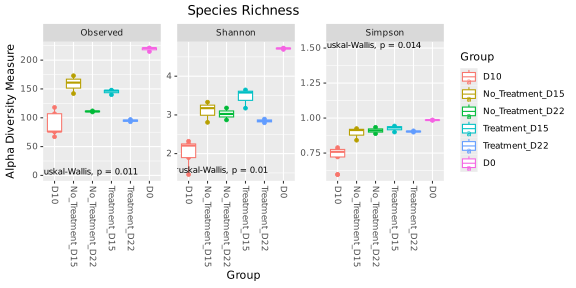
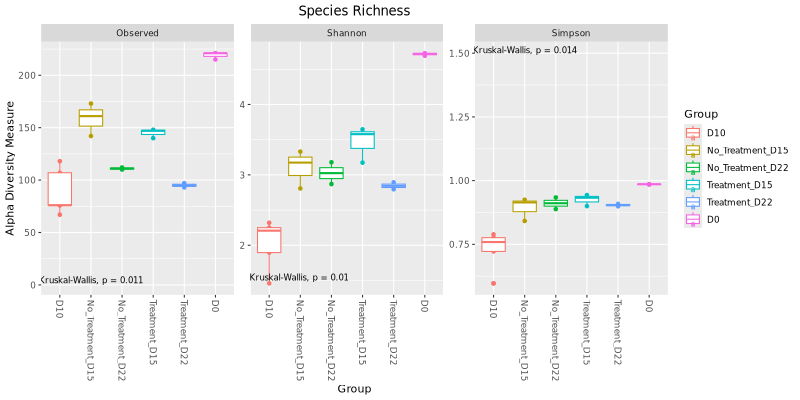
The two main factors taken into account when measuring diversity are richness and evenness. Richness is a measure of the number of different kinds of organisms present in a particular area. Evenness compares the similarity of the population size of each of the species present. There are many different ways to measure the richness and evenness. These measurements are called "estimators" or "indices". Below is a diversity of 3 commonly used indices showing the values for all the samples (dots) and in groups (boxes) at the species level.

Printed on each graph is the statistical significance p values of the difference between the groups. The significance is calculated using either Kruskal-Wallis test or the Wilcoxon rank sum test, both are non-parametric methods (since microbiome read count data are considered non-normally distributed) for testing whether samples originate from the same distribution (i.e., no difference between groups). The Kruskal-Wallis test is used to compare three or more independent groups to determine if there are statistically significant differences between their medians. The Wilcoxon Rank Sum test, also known as the Mann-Whitney U test, is used to compare two independent groups to determine if there is a significant difference between their distributions.
The p-value is shown on the top of each graph. A p-value < 0.05 is considered statistically significant between/among the test groups.

 
Alpha Diversity Box Plots for All Groups - Species Level


Alpha Diversity Box Plots for Individual Comparisons at Species level
 
Comparison 1Treatment_D15 vs No_Treatment_D15View in PDFView in SVG
Comparison 2Treatment_D22 vs No_Treatment_D22View in PDFView in SVG
Comparison 3D0 vs D10View in PDFView in SVG
Comparison 4D0 vs D15View in PDFView in SVG
Comparison 5D0 vs D22View in PDFView in SVG
Comparison 6D0 vs D10 vs D15 vs D22View in PDFView in SVG
 
The above comparisons are at the species-level. Comparisons of other taxonomy levels, from phylum to genus, are also available:


IX. Analysis - Beta Diversity


NMDS and PCoA Plots

Beta diversity compares the similarity (or dissimilarity) of microbial profiles between different groups of samples. There are many different similarity/dissimilarity metrics [8]. In general, they can be quantitative (using sequence abundance, e.g., Bray-Curtis or weighted UniFrac) or binary (considering only presence-absence of sequences, e.g., binary Jaccard or unweighted UniFrac). They can be even based on phylogeny (e.g., UniFrac metrics) or not (non-UniFrac metrics, such as Bray-Curtis, etc.).

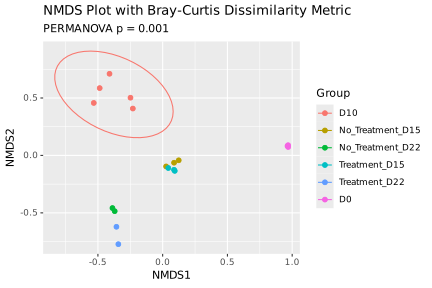
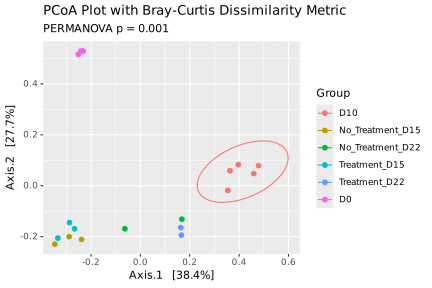
For microbiome studies, species profiles of samples can be compared with the Bray-Curtis dissimilarity, which is based on the count data type. The pair-wise Bray-Curtis dissimilarity matrix of all samples can then be subject to either multi-dimensional scaling (MDS, also known as PCoA) or non-metric MDS (NMDS).

MDS/PCoA is a scaling or ordination method that starts with a matrix of similarities or dissimilarities between a set of samples and aims to produce a low-dimensional graphical plot of the data in such a way that distances between points in the plot are close to original dissimilarities.

NMDS is similar to MDS, however it does not use the dissimilarities data, instead it converts them into the ranks and use these ranks in the calculation.

References:

  1. Plantinga, AM, Wu, MC (2021). Beta Diversity and Distance-Based Analysis of Microbiome Data. In: Datta, S., Guha, S. (eds) Statistical Analysis of Microbiome Data. Frontiers in Probability and the Statistical Sciences. Springer, Cham. https://doi.org/10.1007/978-3-030-73351-3_5

In our beta diversity analysis, Bray-Curtis dissimilarity matrix was first calculated and then plotted by the PCoA and NMDS separately. Below are beta diveristy results for all groups together, at the Species level:


NMDS and PCoA Plots for All Groups - Species Level


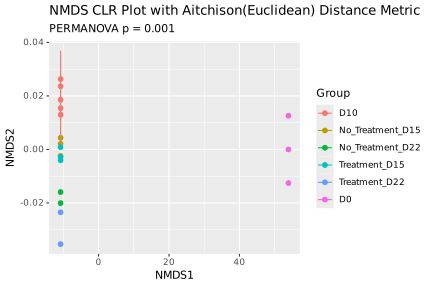
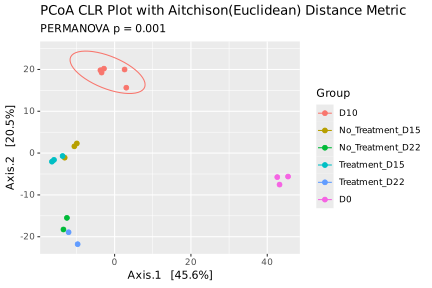
The above PCoA and NMDS plots are based on count data. The count data can also be transformed into centered log ratio (CLR) for each species. The CLR data is no longer count data and cannot be used in Bray-Curtis dissimilarity calculation. Instead CLR can be compared with Euclidean distances. When CLR data are compared by Euclidean distance, the distance is also called Aitchison distance.

Below are the NMDS and PCoA plots of the Aitchison distances of the samples at the Species level:


NMDS and PCoA Plots for Individual Comparisons at Species level
 
 
Comparison No.Comparison NameNMDAPCoA
Bray-CurtisCLR EuclideanBray-CurtisCLR Euclidean
Comparison 1Treatment_D15 vs No_Treatment_D15PDFSVGPDFSVGPDFSVGPDFSVG
Comparison 2Treatment_D22 vs No_Treatment_D22PDFSVGPDFSVGPDFSVGPDFSVG
Comparison 3D0 vs D10PDFSVGPDFSVGPDFSVGPDFSVG
Comparison 4D0 vs D15PDFSVGPDFSVGPDFSVGPDFSVG
Comparison 5D0 vs D22PDFSVGPDFSVGPDFSVGPDFSVG
Comparison 6D0 vs D10 vs D15 vs D22PDFSVGPDFSVGPDFSVGPDFSVG


Interactive 3D PCoA Plots - Bray-Curtis Dissimilarity


Interactive 3D PCoA Plots - Euclidean Distance


Interactive 3D PCoA Plots - Correlation Coefficients


X. Analysis - Differential Abundance

16S rRNA next generation sequencing (NGS) generates a fixed number of reads that reflect the proportion of different species in a sample, i.e., the relative abundance of species, instead of the absolute abundance. In Mathematics, measurements involving probabilities, proportions, percentages, and ppm can all be thought of as compositional data. This makes the microbiome read count data “compositional” (Gloor et al, 2017). In general, compositional data represent parts of a whole which only carry relative information [9].

The problem of microbiome data being compositional arises when comparing two groups of samples for identifying “differentially abundant” species. A species with the same absolute abundance between two conditions, its relative abundances in the two conditions (e.g., percent abundance) can become different if the relative abundance of other species change greatly. This problem can lead to incorrect conclusion in terms of differential abundance for microbial species in the samples.

When studying differential abundance (DA), the current better approach is to transform the read count data into log ratio data. The ratios are calculated between read counts of all species in a sample to a “reference” count (e.g., mean read count of the sample). The log ratio data allow the detection of DA species without being affected by percentage bias mentioned above

In this report, a compositional DA analysis tool “ANCOM” (analysis of composition of microbiomes) was used [10]. ANCOM transforms the count data into log-ratios and thus is more suitable for comparing the composition of microbiomes in two or more populations. "ANCOM" generates a table of features with W-statistics and whether the null hypothesis is rejected. The “W” is the W-statistic, or number of features that a single feature is tested to be significantly different against. Hence the higher the "W" the more statistical sifgnificant that a feature/species is differentially abundant.

References:

  1. Gloor GB, Macklaim JM, Pawlowsky-Glahn V, Egozcue JJ. Microbiome Datasets Are Compositional: And This Is Not Optional. Front Microbiol. 2017 Nov 15;8:2224. doi: 10.3389/fmicb.2017.02224. PMID: 29187837; PMCID: PMC5695134.
  2. Mandal S, Van Treuren W, White RA, Eggesbø M, Knight R, Peddada SD. Analysis of composition of microbiomes: a novel method for studying microbial composition. Microb Ecol Health Dis. 2015 May 29;26:27663. doi: 10.3402/mehd.v26.27663. PMID: 26028277; PMCID: PMC4450248.


ANCOM Differential Abundance Analysis

 
ANCOM Results for Individual Comparisons
Comparison No.Comparison Name
Comparison 1.Treatment_D15 vs No_Treatment_D15
Comparison 2.Treatment_D22 vs No_Treatment_D22
Comparison 3.D0 vs D10
Comparison 4.D0 vs D15
Comparison 5.D0 vs D22
Comparison 6.D0 vs D10 vs D15 vs D22


ANCOM-BC2 Differential Abundance Analysis


Starting with version V1.2, we include the results of ANCOM-BC (Analysis of Compositions of Microbiomes with Bias Correction) (Lin and Peddada 2020) [11]. ANCOM-BC is an updated version of "ANCOM" that:
(a) provides statistically valid test with appropriate p-values,
(b) provides confidence intervals for differential abundance of each taxon,
(c) controls the False Discovery Rate (FDR),
(d) maintains adequate power, and
(e) is computationally simple to implement.

The bias correction (BC) addresses a challenging problem of the bias introduced by differences in the sampling fractions across samples. This bias has been a major hurdle in performing DA analysis of microbiome data. ANCOM-BC estimates the unknown sampling fractions and corrects the bias induced by their differences among samples. The absolute abundance data are modeled using a linear regression framework.

Starting with version V1.43, ANCOM-BC2 is used instead of ANCOM-BC, So that multiple pairwise directional test can be performed (if there are more than two gorups in a comparison). When performing pairwise directional test, the mixed directional false discover rate (mdFDR) is taken into account. The mdFDR is the combination of false discovery rate due to multiple testing, multiple pairwise comparisons, and directional tests within each pairwise comparison. The mdFDR is adopted from (Guo, Sarkar, and Peddada 2010 [12]; Grandhi, Guo, and Peddada 2016 [13]). For more detail explanation and additional features of ANCOM-BC2 please see author's documentation.

References:

  1. Lin H, Peddada SD. Analysis of compositions of microbiomes with bias correction. Nat Commun. 2020 Jul 14;11(1):3514. doi: 10.1038/s41467-020-17041-7. PMID: 32665548; PMCID: PMC7360769.
  2. Guo W, Sarkar SK, Peddada SD. Controlling false discoveries in multidimensional directional decisions, with applications to gene expression data on ordered categories. Biometrics. 2010 Jun;66(2):485-92. doi: 10.1111/j.1541-0420.2009.01292.x. Epub 2009 Jul 23. PMID: 19645703; PMCID: PMC2895927.
  3. Grandhi A, Guo W, Peddada SD. A multiple testing procedure for multi-dimensional pairwise comparisons with application to gene expression studies. BMC Bioinformatics. 2016 Feb 25;17:104. doi: 10.1186/s12859-016-0937-5. PMID: 26917217; PMCID: PMC4768411.
 
 
ANCOM-BC Results for Individual Comparisons
 
Comparison No.Comparison Name
Comparison 1.Treatment_D15 vs No_Treatment_D15
Comparison 2.Treatment_D22 vs No_Treatment_D22
Comparison 3.D0 vs D10
Comparison 4.D0 vs D15
Comparison 5.D0 vs D22
Comparison 6.D0 vs D10 vs D15 vs D22


LEfSe - Linear Discriminant Analysis Effect Size

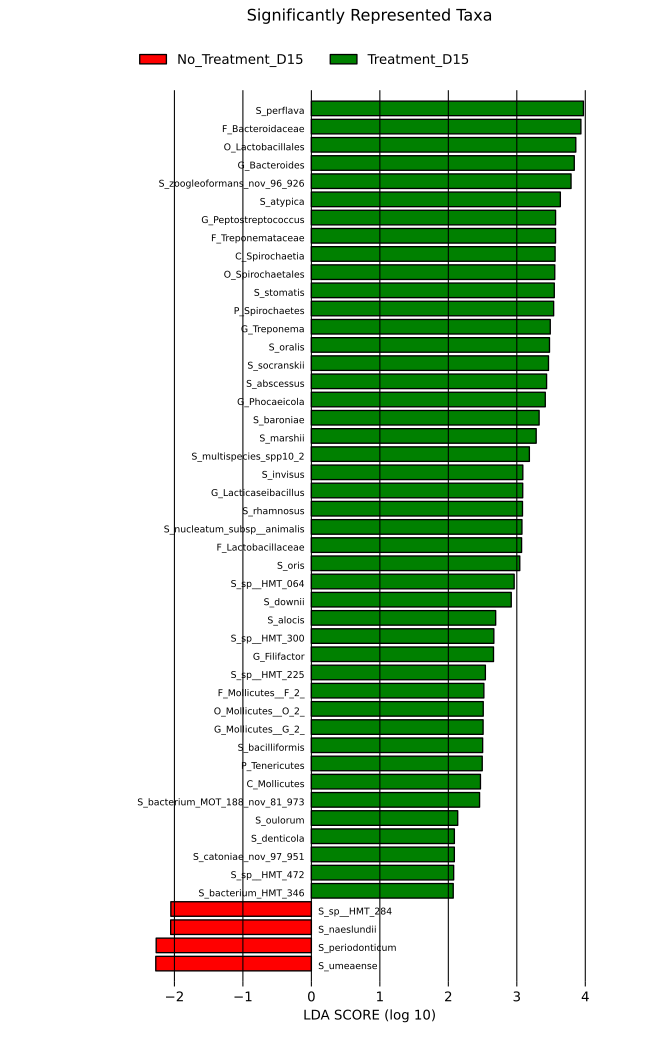
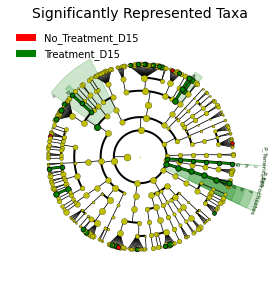
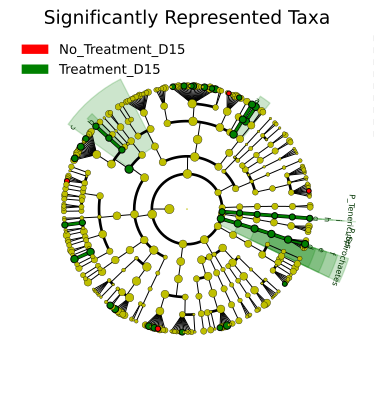
LEfSe (Linear Discriminant Analysis Effect Size) is an alternative method to find "organisms, genes, or pathways that consistently explain the differences between two or more microbial communities" (Segata et al., 2011) [14]. Specifically, LEfSe uses rank-based Kruskal-Wallis (KW) sum-rank test to detect features with significant differential (relative) abundance with respect to the class of interest. Since it is rank-based, instead of proportional based, the differential species identified among the comparison groups is less biased (than percent abundance based).

Reference:

  1. Segata N, Izard J, Waldron L, Gevers D, Miropolsky L, Garrett WS, Huttenhower C. Metagenomic biomarker discovery and explanation. Genome Biol. 2011 Jun 24;12(6):R60. doi: 10.1186/gb-2011-12-6-r60. PMID: 21702898; PMCID: PMC3218848.
 
Treatment_D15 vs No_Treatment_D15


LEfSe Results for All Comparisons
 
Comparison No.Comparison Name
Comparison 1.Treatment_D15 vs No_Treatment_D15
Comparison 2.Treatment_D22 vs No_Treatment_D22
Comparison 3.D0 vs D10
Comparison 4.D0 vs D15
Comparison 5.D0 vs D22
Comparison 6.D0 vs D10 vs D15 vs D22


XI. Analysis - Heatmap Profile


Species vs Sample Abundance Heatmap for All Samples


Heatmaps for Individual Comparisons

 
A) Two-way clustering - clustered on both columns (Samples) and rows (organism)
Comparison No.Comparison NameFamily LevelGenus LevelSpecies Level
Comparison 1Treatment_D15 vs No_Treatment_D15PDFSVGPDFSVGPDFSVG
Comparison 2Treatment_D22 vs No_Treatment_D22PDFSVGPDFSVGPDFSVG
Comparison 3D0 vs D10PDFSVGPDFSVGPDFSVG
Comparison 4D0 vs D15PDFSVGPDFSVGPDFSVG
Comparison 5D0 vs D22PDFSVGPDFSVGPDFSVG
Comparison 6D0 vs D10 vs D15 vs D22PDFSVGPDFSVGPDFSVG
 
 
B) One-way clustering - clustered on rows (organism) only
Comparison No.Comparison NameFamily LevelGenus LevelSpecies Level
Comparison 1Treatment_D15 vs No_Treatment_D15PDFSVGPDFSVGPDFSVG
Comparison 2Treatment_D22 vs No_Treatment_D22PDFSVGPDFSVGPDFSVG
Comparison 3D0 vs D10PDFSVGPDFSVGPDFSVG
Comparison 4D0 vs D15PDFSVGPDFSVGPDFSVG
Comparison 5D0 vs D22PDFSVGPDFSVGPDFSVG
Comparison 6D0 vs D10 vs D15 vs D22PDFSVGPDFSVGPDFSVG
 
 
C) No clustering
Comparison No.Comparison NameFamily LevelGenus LevelSpecies Level
Comparison 1Treatment_D15 vs No_Treatment_D15PDFSVGPDFSVGPDFSVG
Comparison 2Treatment_D22 vs No_Treatment_D22PDFSVGPDFSVGPDFSVG
Comparison 3D0 vs D10PDFSVGPDFSVGPDFSVG
Comparison 4D0 vs D15PDFSVGPDFSVGPDFSVG
Comparison 5D0 vs D22PDFSVGPDFSVGPDFSVG
Comparison 6D0 vs D10 vs D15 vs D22PDFSVGPDFSVGPDFSVG


XII. Analysis - Network Association

To analyze the co-occurrence or co-exclusion between microbial species among different samples, network correlation analysis tools are usually used for this purpose. However, microbiome count data are compositional. If count data are normalized to the total number of counts in the sample, the data become not independent and traditional statistical metrics (e.g., correlation) for the detection of specie-species relationships can lead to spurious results. In addition, sequencing-based studies typically measure hundreds of OTUs (species) on few samples; thus, inference of OTU-OTU association networks is severely under-powered. We provide the network association result with SparCC (Sparse Correlations for Compositional data)(Friedman & Alm 2012), which is a method for inferring correlations from compositional data. SparCC estimates the linear Pearson correlations between the log-transformed components.


References:

Friedman J, Alm EJ. Inferring correlation networks from genomic survey data. PLoS Comput Biol. 2012;8(9):e1002687. doi: 10.1371/journal.pcbi.1002687. Epub 2012 Sep 20. PMID: 23028285; PMCID: PMC3447976.


Association Network Inference by SparCC


XIII. Disclaimer

The results of this analysis are for research purpose only. They are not intended to diagnose, treat, cure, or prevent any disease. Forsyth and FOMC are not responsible for use of information provided in this report outside the research area.

 

Copyright FOMC 2025